01 / Chalk Farm and Swiss Cottage · NW3

Adelaide Road
History behind the address.

Adelaide Road links Chalk Farm with Swiss Cottage, passing through a landscape shaped by nineteenth-century housebuilding and the railway. It was named for Queen Adelaide and laid out in 1830, although construction of houses followed later in the decade. The Birmingham-to-Euston railway and the nearby Primrose Hill Tunnel influenced development from an early stage. The resulting street combined suburban homes with an unusually close relationship to major transport infrastructure.

Later rebuilding has made the road more varied than its earliest terraces and villas suggest. Surviving older houses stand alongside apartment blocks, public housing and other twentieth-century additions. The railway corridor remains an important physical boundary, while adjoining roads lead towards the residential districts around Primrose Hill and Belsize Park. This mixture gives Adelaide Road a different character from a uniform garden square: it is a long connecting street whose buildings record several phases of London’s outward growth.

History sources
Explore its people and history
Adelaide Road near Swiss Cottage, photographed in December 2023; DiscoA340, Wikimedia Commons, CC BY-SA 4.0.
Adelaide Road near Swiss Cottage, photographed in December 2023; DiscoA340, Wikimedia Commons, CC BY-SA 4.0. DiscoA340 · Wikimedia Commons · CC BY-SA 4.0

This history is growing. Further directory research and photographs will be added.

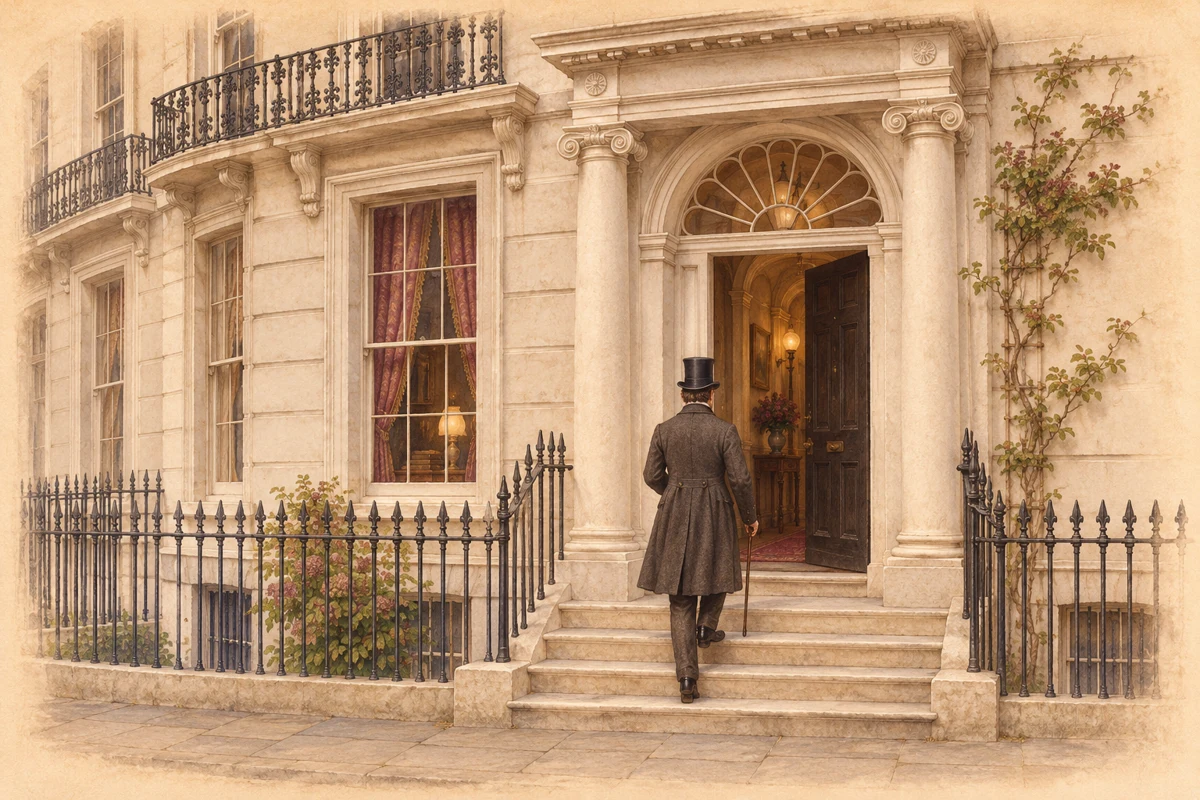
Illustration of a Victorian gentleman entering a London terraced house, viewed from behind
Another day, another life, behind a familiar door.AI-generated period illustration; not an archival photograph.

02 / People behind the doors

Adelaide Road’s
people and stories.

A few lives that connect this neighbourhood with a much wider story.

Cecil James Sharp

No. 183 Adelaide Road

Sharp was a leading figure in the collection and revival of English folk song and dance. His fieldwork recorded music from singers in England and, later, the Appalachian region of the United States. He helped establish the English Folk Dance Society in 1911.

Sources and directory references

Selected directory observations: Royal Blue Book 1907, printed page 136 (PDF page 175), column 3: 183 Sharp, Cecil James. Page references are PDF pages. These observations do not establish continuous residence.

James Bolivar Manson

No. 184 Adelaide Road

Manson was a painter who combined his own artistic work with a long career at the Tate. He joined its staff in 1912 and became director in 1930, serving until 1938. His interests included Impressionism, although his directorship proved contentious as newer movements gained attention. The Adelaide Road entries identify him as an artist before his museum career began.

Sources and directory references

Selected directory observations: Royal Blue Book 1907, printed page 137 (PDF page 176), column 3: 184 Manson, Jas. B. artist. Page references are PDF pages. These observations do not establish continuous residence.

George Cecil Ives

No. 196 Adelaide Road

Ives was a poet, diarist and campaigner concerned with prison reform and the treatment of homosexual people. He founded the Order of Chaeronea, a private society that sought greater understanding and acceptance, and wrote on crime and punishment. His extensive diaries became an important historical record.

Sources and directory references

Selected directory observations: Royal Blue Book 1907, printed page 137 (PDF page 176), column 3: 196 Ives, George Cecil. Page references are PDF pages. These observations do not establish continuous residence.

04 / Keep exploring

More history.
Freely discovered.

These collections are a good place to follow your curiosity. Browse their online records free; copies, downloads or permission to reproduce images may carry a charge.

Streets.London is a project by Infrastructure.London.
More ways we care for London’s homes and gardens.

Your details, thoughtfully handled.

Who we are. Streets.London is a project of London Infrastructure Solutions.

Launch updates. With your consent, we use your email address, optional street and postcode interests, the page where you signed up, and any organisation and property-count details you provide to handle group enquiries and send Streets.London launch and record-availability updates. These details are submitted to Brevo to manage our subscriber list. The optional email-update form does not create an account or purchase anything. Free account registration is separate; see our account privacy notice.

Keeping and removing your details. We keep signup information while it is needed for these updates. You can withdraw consent, ask for a copy or correction, or request deletion using the unsubscribe link in our emails, by replying to an update from us or using the London Infrastructure Solutions contact form. We will stop updates when you withdraw consent.

Services we use. Our hosting provider serves this website. Brevo processes signup details and manages our email updates, while Cloudflare Turnstile checks for automated abuse. These providers may process information outside the UK. We do not sell your signup information.

Analytics. If you allow optional analytics, Google Analytics helps us understand page visits and completed signups. We do not send your form email address, street interest or postcode to Google Analytics. Your cookie choice is stored on this device and can be changed using “Cookie choices”.

Your rights. You may ask us to access, correct or delete your information or withdraw consent. You can also raise a concern with the UK Information Commissioner’s Office at ico.org.uk.

Last updated: 15 November 2026.