

01 / South Kensington · SW3

Alexander Square
History behind the address.

Alexander Square was developed between 1827 and 1830 on the Thurloe Estate, a wedge of land within the larger Henry Smith’s Charity Estate. John Alexander had acquired the estate in 1799 and began its housing development in 1826 through an agreement with builder James Bonnin. George Basevi was appointed architect in 1829 and designed the north terrace, contributing to the planned residential growth of this part of South Kensington.

The square has an unusual arrangement of two terraces divided by Alexander Place. Private access roads run in front of the houses, while narrow, railed gardens separate them from the main road. Trees give these planted strips a substantial presence despite their limited depth. The combination of terraces, small garden enclosures and quieter access roads creates a sheltered domestic setting within the wider network of estate streets.

History sources
Explore its people and history
Alexander Square
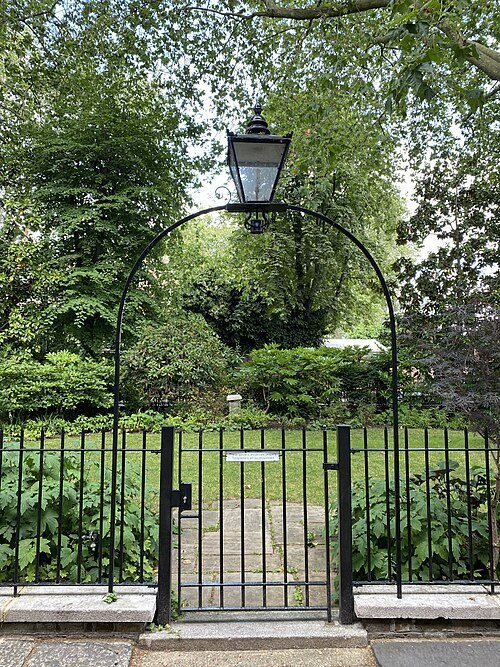
Entrance to Alexander Square’s communal garden in July 2023, photographed by No Swan So Fine; Wikimedia Commons. No Swan So Fine · Wikimedia Commons · CC BY-SA 4.0

This history is growing. Further directory research and photographs will be added.

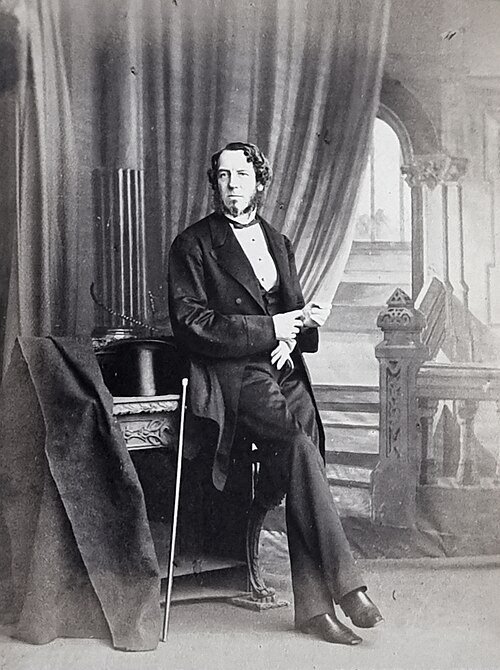
George Godwin, photographed by Ernest Edwards around 1863; Wikimedia Commons, public domain.
George Godwin, photographed by Ernest Edwards around 1863; Wikimedia Commons, public domain. Ernest Edwards · Wikimedia Commons · Public domain

02 / People behind the doors

Alexander Square’s
people and stories.

A few lives that connect this neighbourhood with a much wider story.

George Godwin

No. 24 Alexander Square · listed in 1848

Godwin was an architect and journalist who edited The Builder. His career brought architectural practice together with the expanding nineteenth-century press, giving building design and the conditions of urban life a prominent place in public discussion.

Sources and directory references

Selected directory observations: Webster’s 1848, printed page 19 (PDF page 28), column 1: 24 GODWIN, G. jun... Page references are PDF pages. These observations do not establish continuous residence.


Edward Hargitt

No. 10 Alexander Square · listed in 1874

Hargitt was a Scottish landscape painter and ornithologist with a particular interest in woodpeckers. He wrote the eighteenth volume of the Catalogue of Birds, bringing sustained specialist research to the classification of a diverse group of birds.

Sources and directory references

Selected directory observations: Boyle’s 1874, PDF page 45, column 2: 10 Edward Hargitt.. Page references are PDF pages. These observations do not establish continuous residence.
Sir Andrew Smith

No. 16 Alexander Square · listed in 1866

Smith explored and documented the wildlife of southern Africa. His major work, Illustrations of the Zoology of South Africa, described species across several animal groups. His contribution to natural history extended well beyond the medical profession in which he originally trained.

Sources and directory references

Selected directory observations: Boyle’s 1866, PDF page 43, column 2: 16 Sir Andrew Smith . К.С.В... Page references are PDF pages. These observations do not establish continuous residence.

David George Hogarth

No. 23 Alexander Square · listed in 1903

Hogarth was an archaeologist and scholar who later served as Keeper of the Ashmolean Museum from 1909 to 1927. During the First World War he also worked in naval intelligence and briefly directed the Arab Bureau, connecting scholarship with international affairs.

Sources and directory references

Selected directory observations: Webster’s 1903, printed page 10 (PDF page 75), column 2: 23 HOGARTH, D. G... Page references are PDF pages. These observations do not establish continuous residence.

04 / Keep exploring

More history.
Freely discovered.

These collections are a good place to follow your curiosity. Browse their online records free; copies, downloads or permission to reproduce images may carry a charge.

Streets.London is a project by Infrastructure.London.
More ways we care for London’s homes and gardens.

Your details, thoughtfully handled.

Who we are. Streets.London is a project of London Infrastructure Solutions.

Launch updates. With your consent, we use your email address, optional street and postcode interests, the page where you signed up, and any organisation and property-count details you provide to handle group enquiries and send Streets.London launch and record-availability updates. These details are submitted to Brevo to manage our subscriber list. The optional email-update form does not create an account or purchase anything. Free account registration is separate; see our account privacy notice.

Keeping and removing your details. We keep signup information while it is needed for these updates. You can withdraw consent, ask for a copy or correction, or request deletion using the unsubscribe link in our emails, by replying to an update from us or using the London Infrastructure Solutions contact form. We will stop updates when you withdraw consent.

Services we use. Our hosting provider serves this website. Brevo processes signup details and manages our email updates, while Cloudflare Turnstile checks for automated abuse. These providers may process information outside the UK. We do not sell your signup information.

Analytics. If you allow optional analytics, Google Analytics helps us understand page visits and completed signups. We do not send your form email address, street interest or postcode to Google Analytics. Your cookie choice is stored on this device and can be changed using “Cookie choices”.

Your rights. You may ask us to access, correct or delete your information or withdraw consent. You can also raise a concern with the UK Information Commissioner’s Office at ico.org.uk.

Last updated: 15 November 2026.