01 / Bayswater · W2

Bayswater Hill
History behind the address.

Bayswater Hill was a historic address on the park-side edge of Bayswater, close to the present Orme Court area. Its houses belonged to an earlier landscape of villas and garden plots beside the road along Kensington Gardens. The outlook over open space distinguished this frontage from the streets developing further north, while the route itself connected London with the growing western suburbs.

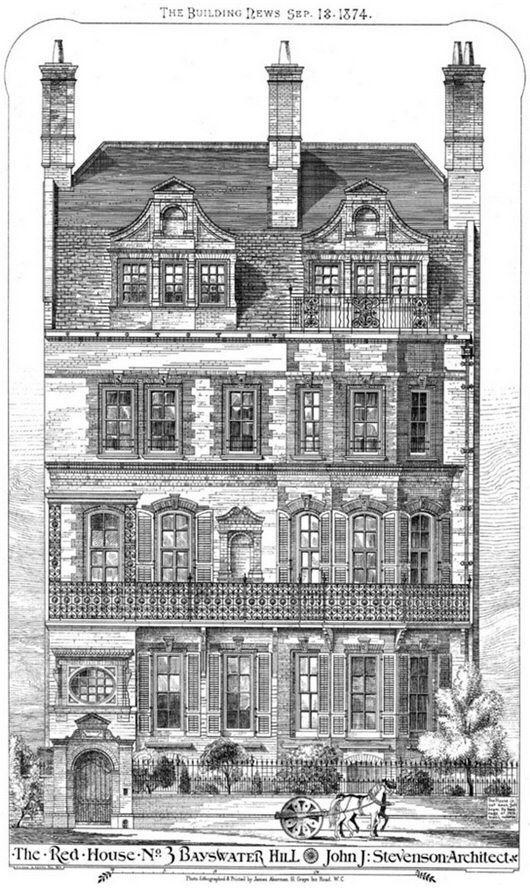
Later nineteenth-century redevelopment changed this setting as older leases expired and substantial houses gave way to new streets and denser building. The creation of Palace Court and the development of adjoining frontages formed part of that transformation. Historical views, including the engraving of the Red House shown here, record buildings that no longer survive. The directory numbers used below therefore belong to Bayswater Hill’s own numbering and should not be read as present-day addresses on Bayswater Road.

History sources
Explore its people and history
The Red House, No. 3 Bayswater Hill, in an 1874 illustration by J. J. Stevenson; Wikimedia Commons, public domain.
The Red House, No. 3 Bayswater Hill, in an 1874 illustration by J. J. Stevenson; Wikimedia Commons, public domain. J. J. Stevenson · Wikimedia Commons · Public domain

This history is growing. Further directory research and photographs will be added.

Publisher Thomas Dixon Galpin, reproduced in The Sketch, 25 November 1896; Wikimedia Commons, public domain.
Publisher Thomas Dixon Galpin, reproduced in The Sketch, 25 November 1896; Wikimedia Commons, public domain. Unknown author Unknown author · Wikimedia Commons · Public domain

02 / People behind the doors

Bayswater Hill’s
people and stories.

A few lives that connect this neighbourhood with a much wider story.

Thomas Hopper

No. 1 Bayswater Hill · listed in 1851–52

Hopper was an architect who worked in several historical styles, ranging from classical country houses to Gothic and Norman-inspired buildings. His most spectacular surviving work is Penrhyn Castle in north Wales, where elaborate interiors and monumental exterior forms created an imposing country house. Its scale reflects the wealth of an estate whose fortunes were connected with slate quarrying and colonial slavery.

Sources and directory references

Selected directory observations: Webster’s 1851, printed page 13 (PDF page 56), column 3: 1 HOPPER, Thos .; Webster’s 1852, printed page 11 (PDF page 56), column 1: 1 HOPPER, Thos .. Page references are PDF pages. These observations do not establish continuous residence.

John James Stevenson

The Red House, No. 3 Bayswater Hill · listed in 1874–75

Stevenson was a Scottish architect associated with the revival of red-brick domestic architecture often called Queen Anne. He designed houses and schools and explained his ideas in the illustrated book House Architecture, published in 1880. His own Red House at Bayswater Hill became an influential example of this approach, combining picturesque form with an interest in practical domestic planning.

Sources and directory references

Selected directory observations: Webster’s 1874, printed page 15 (PDF page 80), column 3: 3 STEVENSON , J. J.; Webster’s 1875, PDF page 81, column 1: 3 STEVENSON , J. J.. Page references are PDF pages. These observations do not establish continuous residence.

Thomas Dixon Galpin

No. 1 Bayswater Hill · listed in 1898–99

Galpin was a publisher and partner in the firm of Cassell, Petter and Galpin. The business became known for illustrated periodicals, reference works and books intended for a broad readership. Its combination of accessible prices and large-scale publishing helped bring educational and literary material into many Victorian households. Boyle’s gives Galpin’s distinctive full name at No. 1.

Sources and directory references

Selected directory observations: Boyle’s 1898, PDF page 49, column 2: 1 Thomas Dixon Galpin; Boyle’s 1899, PDF page 49, column 1: 1 Thomas Dixon Galpin. Page references are PDF pages. These observations do not establish continuous residence.

04 / Keep exploring

More history.
Freely discovered.

These collections are a good place to follow your curiosity. Browse their online records free; copies, downloads or permission to reproduce images may carry a charge.

Streets.London is a project by Infrastructure.London.
More ways we care for London’s homes and gardens.

Your details, thoughtfully handled.

Who we are. Streets.London is a project of London Infrastructure Solutions.

Launch updates. With your consent, we use your email address, optional street and postcode interests, the page where you signed up, and any organisation and property-count details you provide to handle group enquiries and send Streets.London launch and record-availability updates. These details are submitted to Brevo to manage our subscriber list. The optional email-update form does not create an account or purchase anything. Free account registration is separate; see our account privacy notice.

Keeping and removing your details. We keep signup information while it is needed for these updates. You can withdraw consent, ask for a copy or correction, or request deletion using the unsubscribe link in our emails, by replying to an update from us or using the London Infrastructure Solutions contact form. We will stop updates when you withdraw consent.

Services we use. Our hosting provider serves this website. Brevo processes signup details and manages our email updates, while Cloudflare Turnstile checks for automated abuse. These providers may process information outside the UK. We do not sell your signup information.

Analytics. If you allow optional analytics, Google Analytics helps us understand page visits and completed signups. We do not send your form email address, street interest or postcode to Google Analytics. Your cookie choice is stored on this device and can be changed using “Cookie choices”.

Your rights. You may ask us to access, correct or delete your information or withdraw consent. You can also raise a concern with the UK Information Commissioner’s Office at ico.org.uk.

Last updated: 15 November 2026.