

01 / Bloomsbury · WC1

Bedford Way
History behind the address.

Bedford Way history begins under an earlier name: Upper Bedford Place. The Survey of London’s account of University College London traces its development on the Bedford estate in the early nineteenth century, within the building campaign associated with James Burton. The street extended the ordered residential landscape around Russell Square. Historical maps show the terraces that once lined it, providing the setting for the directory addresses below.

The twentieth-century growth of the university profoundly changed this part of Bloomsbury. Institutional buildings replaced much of the earlier domestic fabric, so a historical address on Upper Bedford Place cannot safely be treated as an unchanged modern doorway on Bedford Way. The guides preserve the people of that earlier street: a physician studying recurring illness, an architect exchanging scholarly introductions, and a correspondent helping scientific ideas reach readers abroad.

History sources
Explore its people and history
Illustrated London terraces emerging from an open book; a general London illustration, not a view of Bedford Way
A London story begins with an address. A photograph of Bedford Way will follow. Streets.London · AI-generated illustration; not an archival photograph.

This history is growing. Further directory research and photographs will be added.

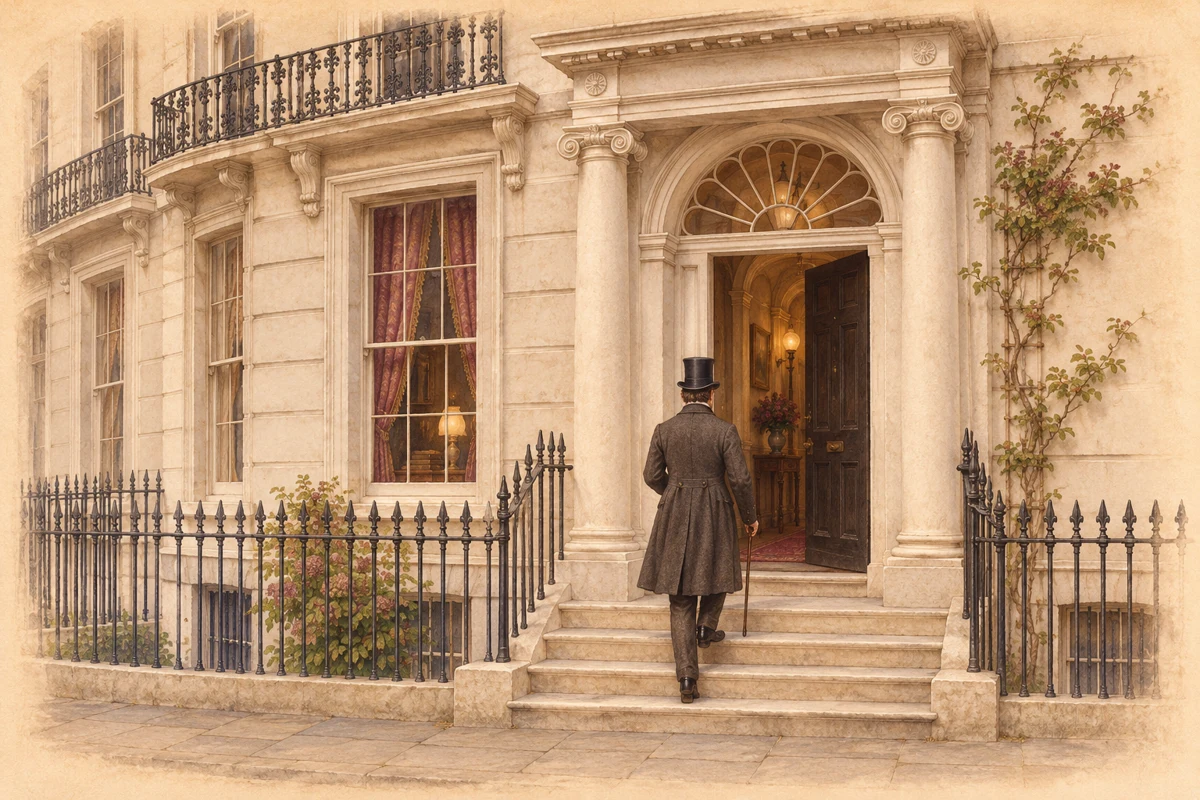
Illustration of a Victorian gentleman entering a London terraced house, viewed from behind
Another day, another life, behind a familiar door.AI-generated period illustration; not an archival photograph.

02 / People behind the doors

Bedford Way’s
people and stories.

A few lives that connect this neighbourhood with a much wider story.

Max Schlesinger

Historical No. 25 Upper Bedford Place · now Bedford Way

Max Schlesinger is recorded at No. 25 under the street’s former name, Upper Bedford Place. A letter to Charles Darwin dated 4 July 1877 independently gives this address. Writing as the London representative of the Cologne Gazette, Schlesinger thanked Darwin for permission to translate an article published in Mind and arranged to send newspaper copies. The letter gives a specific example of the work behind the directory name: communication between British science and a German-speaking readership. Although the directories attach medical initials to his name, this evidence establishes his role as a journalist and intermediary, not a consulting practice at the house.

Sources and directory references

Selected directory observations: Boyle’s 1868, PDF p. 51 (1868_BG); Boyle’s 1869, PDF p. 52 (1869_BG); Webster’s 1876, PDF p. 80 (1876_WB); Webster’s 1880, PDF p. 84 (1880_WB). Page references are PDF pages. These observations do not establish continuous residence.


Thomas Leverton Donaldson

Historical No. 21 Upper Bedford Place · now Bedford Way

Thomas Leverton Donaldson, the architect recorded at No. 21, was an influential figure in the Royal Institute of British Architects, receiving its Royal Gold Medal in 1851 and serving as president in 1863–64. Correspondence preserved by the British School at Athens independently gives his Upper Bedford Place address. In March 1872 he wrote to the historian George Finlay with an introduction for the geologist David Thomas Ansted. Such letters connect the house with a network of architectural, classical and scientific interests extending beyond London. Donaldson died at this home in 1885.

Sources and directory references

Selected directory observations: Boyle’s 1872, PDF p. 50 (1872_BG); Boyle’s 1874, PDF p. 52 (1874_BG); Webster’s 1876, PDF p. 80 (1876_WB); Webster’s 1880, PDF p. 84 (1880_WB). Page references are PDF pages. These observations do not establish continuous residence.
John Bostock

Historical No. 22 Upper Bedford Place · now Bedford Way

Dr Bostock at No. 22 was John Bostock, the physician and author whose account of hay fever was presented to the Medical and Chirurgical Society in 1819. His full name and Upper Bedford Place address appear in the Post Office directory of 1843 and in contemporary medical society records. Bostock also published the three-volume Elementary System of Physiology in 1824–27 and served as president of the Geological Society. A historical study in the Journal of the Royal Society of Medicine records his death at No. 22 in 1846, connecting the scientific biography securely with the directory household.

Sources and directory references

Selected directory observations: Boyle’s 1823, PDF p. 24 (1823_BG); Boyle’s 1824, PDF p. 23 (1824_BG). Page references are PDF pages. These observations do not establish continuous residence.

04 / Keep exploring

More history.
Freely discovered.

These collections are a good place to follow your curiosity. Browse their online records free; copies, downloads or permission to reproduce images may carry a charge.

More nearby streets in the London Picture Archive: Upper Bedford Place

Streets.London is a project by Infrastructure.London.
More ways we care for London’s homes and gardens.

Your details, thoughtfully handled.

Who we are. Streets.London is a project of London Infrastructure Solutions.

Launch updates. With your consent, we use your email address, optional street and postcode interests, the page where you signed up, and any organisation and property-count details you provide to handle group enquiries and send Streets.London launch and record-availability updates. These details are submitted to Brevo to manage our subscriber list. The optional email-update form does not create an account or purchase anything. Free account registration is separate; see our account privacy notice.

Keeping and removing your details. We keep signup information while it is needed for these updates. You can withdraw consent, ask for a copy or correction, or request deletion using the unsubscribe link in our emails, by replying to an update from us or using the London Infrastructure Solutions contact form. We will stop updates when you withdraw consent.

Services we use. Our hosting provider serves this website. Brevo processes signup details and manages our email updates, while Cloudflare Turnstile checks for automated abuse. These providers may process information outside the UK. We do not sell your signup information.

Analytics. If you allow optional analytics, Google Analytics helps us understand page visits and completed signups. We do not send your form email address, street interest or postcode to Google Analytics. Your cookie choice is stored on this device and can be changed using “Cookie choices”.

Your rights. You may ask us to access, correct or delete your information or withdraw consent. You can also raise a concern with the UK Information Commissioner’s Office at ico.org.uk.

Last updated: 15 November 2026.