01 / St James’s · SW1

Bury Street
History behind the address.

Bury Street was created during the 1670s as St James’s developed around its new residential square. The district combined grand houses for courtiers and aristocrats with smaller properties in the adjoining streets. Bury Street belongs to that more compact network, where houses, lodgings and later hotels accommodated people who wanted a London base near the court and the social life of the West End.

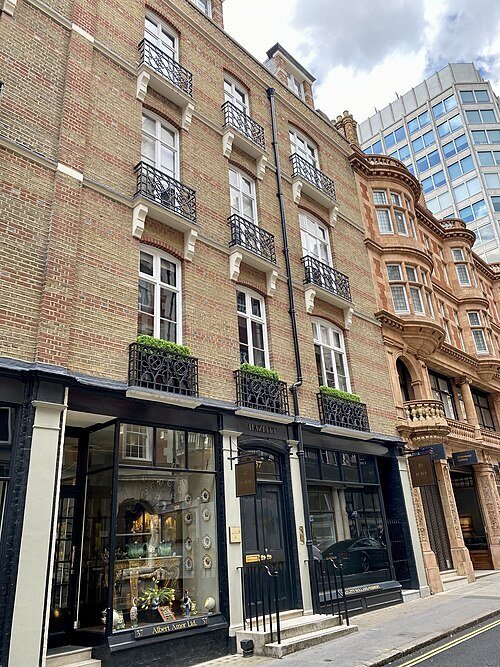
Later rebuilding introduced larger blocks while retaining the narrow street pattern. At the junction with Ryder Street, an early-twentieth-century development combined ground-floor shops with flats and offices above. Decorative chimneys, projecting windows and elaborate rooflines gave these buildings a distinctive appearance. Art dealers and specialist shops subsequently occupied many of the lower floors, creating the mixture of domestic accommodation and commercial display that remains characteristic of the neighbourhood.

History sources
Explore its people and history
Bury Street
The buildings at 37–38 Bury Street, St James’s; Wikimedia Commons. No Swan So Fine · Wikimedia Commons · CC BY-SA 4.0

This history is growing. Further directory research and photographs will be added.

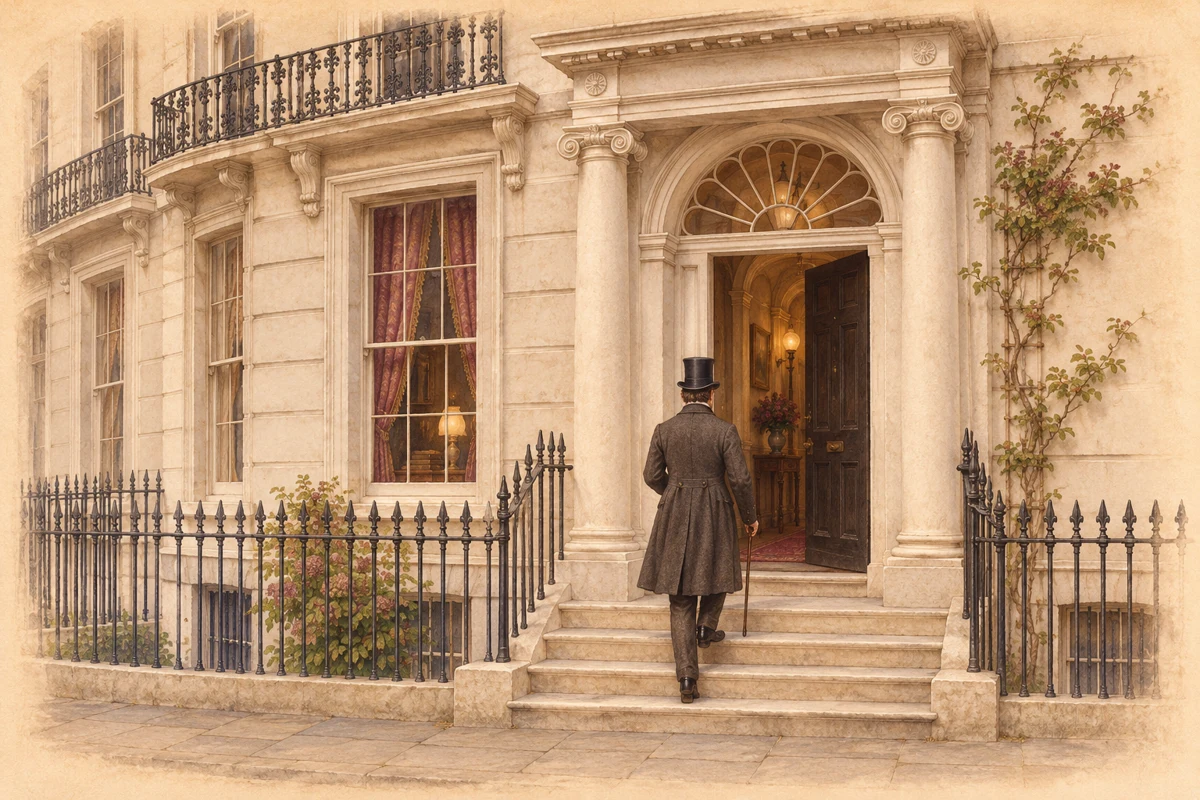
Illustration of a Victorian gentleman entering a London terraced house, viewed from behind
Another day, another life, behind a familiar door.AI-generated period illustration; not an archival photograph.

02 / People behind the doors

Bury Street’s
people and stories.

A few lives that connect this neighbourhood with a much wider story.

Rudolph Chambers Lehmann

No. 30 Bury Street · listed as R. C. Lehmann in 1893

Lehmann was a writer, politician and rowing coach. A founding editor of Granta and a long-standing contributor to Punch, he combined literary work with sport and public life. He later represented Harborough in Parliament as a Liberal.

Sources and directory references

Selected directory observations: Webster’s 1893, printed page 39 (PDF page 110), column 2: 30 LEHMANN, R. C... Page references are PDF pages. These observations do not establish continuous residence.

Edward Carson

No. 19 Bury Street · listed as E. H. Carson, QC, MP, in 1893

Carson was a barrister and politician who became the leading figure in Ulster opposition to Irish Home Rule. He held senior legal and ministerial offices and played a central role in the politics that led to partition. His career connected courtroom advocacy with constitutional conflict.

Sources and directory references

Selected directory observations: Webster’s 1893, printed page 39 (PDF page 110), column 1: 19 CARSON, E. H. Q. C. M.P... Page references are PDF pages. These observations do not establish continuous residence.

Mark Ambient

No. 6 Bury Street · listed in 1893

Ambient was the pen name of actor and dramatist Harold Harley. He is particularly remembered as a writer of The Arcadians, the successful musical comedy first staged in 1909. His work belongs to the flourishing theatrical entertainment of the late-Victorian and Edwardian West End.

Sources and directory references

Selected directory observations: Webster’s 1893, printed page 39 (PDF page 110), column 1: 6 AMBIENT, Mark.. Page references are PDF pages. These observations do not establish continuous residence.

04 / Keep exploring

More history.
Freely discovered.

These collections are a good place to follow your curiosity. Browse their online records free; copies, downloads or permission to reproduce images may carry a charge.

Streets.London is a project by Infrastructure.London.
More ways we care for London’s homes and gardens.

Your details, thoughtfully handled.

Who we are. Streets.London is a project of London Infrastructure Solutions.

Launch updates. With your consent, we use your email address, optional street and postcode interests, the page where you signed up, and any organisation and property-count details you provide to handle group enquiries and send Streets.London launch and record-availability updates. These details are submitted to Brevo to manage our subscriber list. The optional email-update form does not create an account or purchase anything. Free account registration is separate; see our account privacy notice.

Keeping and removing your details. We keep signup information while it is needed for these updates. You can withdraw consent, ask for a copy or correction, or request deletion using the unsubscribe link in our emails, by replying to an update from us or using the London Infrastructure Solutions contact form. We will stop updates when you withdraw consent.

Services we use. Our hosting provider serves this website. Brevo processes signup details and manages our email updates, while Cloudflare Turnstile checks for automated abuse. These providers may process information outside the UK. We do not sell your signup information.

Analytics. If you allow optional analytics, Google Analytics helps us understand page visits and completed signups. We do not send your form email address, street interest or postcode to Google Analytics. Your cookie choice is stored on this device and can be changed using “Cookie choices”.

Your rights. You may ask us to access, correct or delete your information or withdraw consent. You can also raise a concern with the UK Information Commissioner’s Office at ico.org.uk.

Last updated: 15 November 2026.