01 / St James’s · SW1

Carlton Gardens
History behind the address.

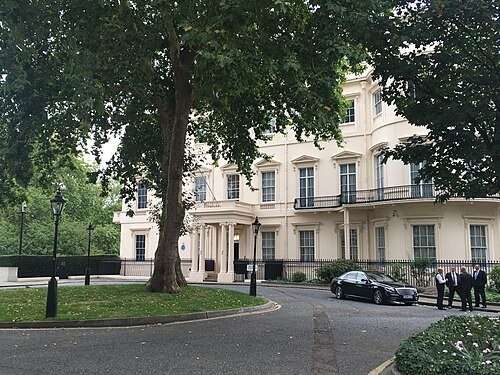
Carlton Gardens emerged from the redevelopment of the grounds of Carlton House, the former residence of the Prince Regent. After the house was demolished in 1827, John Nash’s scheme replaced it with substantial residences overlooking the royal park. Built in the early 1830s, the gardens formed the western continuation of Carlton House Terrace, giving this secluded corner of St James’s a deliberately grand residential character.

The relationship between houses and planted space remains central to the neighbourhood. Trees, shrubs, curving paths and substantial railings softened the formal architecture and separated the residences from the busier surrounding streets. During the twentieth century, changing demand brought pressure to replace houses with offices. Parliamentary debates in 1932 show how strongly this challenged the established character of an area conceived for domestic life on a monumental scale.

History sources
Explore its people and history
Carlton Gardens
Carlton Gardens, showing its houses and planted setting; Wikimedia Commons. Stuart Taylor · Wikimedia Commons · CC BY-SA 2.0

This history is growing. Further directory research and photographs will be added.

Frances, Countess Waldegrave, in an 1876 lithograph by A. Maclure; British Museum collection via Wikimedia Commons, public domain.
Frances, Countess Waldegrave, in an 1876 lithograph by A. Maclure; British Museum collection via Wikimedia Commons, public domain. Print made by: A Maclure Printed by: Maclure, Macdonald & Macgregor · Wikimedia Commons · Public domain

02 / People behind the doors

Carlton Gardens’s
people and stories.

A few lives that connect this neighbourhood with a much wider story.

Frances Waldegrave

No. 7 Carlton Gardens · listed in 1863

Waldegrave was a prominent Victorian society hostess whose gatherings brought together leading figures in Liberal politics. The daughter of singer John Braham, she used her wealth and social position to create an influential political circle, notably at Strawberry Hill.

Sources and directory references

Selected directory observations: Webster’s 1863, printed page 39 (PDF page 84), column 1: 7 WALDEGRAVE, Fran- ces, Countess of.. Page references are PDF pages. These observations do not establish continuous residence.

Arthur Balfour

No. 4 Carlton Gardens · listed as A. J. Balfour, MP, in 1877

Balfour served as prime minister from 1902 to 1905 and later as foreign secretary. His political career included the 1902 Education Act and the 1917 Balfour Declaration, which supported a Jewish national home in Palestine and had far-reaching consequences.

Sources and directory references

Selected directory observations: Webster’s 1877, printed page 46 (PDF page 109), column 1: 4 BALFOUR,A.J.M.P... Page references are PDF pages. These observations do not establish continuous residence.

William Ewart Gladstone

No. 6 Carlton Gardens · listed in 1849

Gladstone served four terms as prime minister and became the dominant figure in Victorian Liberal politics. His long parliamentary career encompassed financial reform, changes to voting rights and the struggle over Irish Home Rule. He entered politics as a Conservative before becoming a Liberal leader.

Sources and directory references

Selected directory observations: Webster’s 1849, printed page 46 (PDF page 55), column 2: 6 GLADSTONE, Rt. Hon. W. E. M.P... Page references are PDF pages. These observations do not establish continuous residence.

Alice Blanche Balfour

No. 4 Carlton Gardens · listed as Miss Balfour in 1887

Balfour was a naturalist and scientific illustrator whose moth collection remains valuable to the study of Scotland’s wildlife. She pursued research while managing the households of her brother Arthur, the future prime minister. Her specimens are now held by National Museums Scotland, where they provide evidence of changes in moth populations over time.

Sources and directory references

Selected directory observations: Webster’s 1887, printed page 45 (PDF page 120), column 2: BALFOUR, Miss.. Page references are PDF pages. These observations do not establish continuous residence.

04 / Keep exploring

More history.
Freely discovered.

These collections are a good place to follow your curiosity. Browse their online records free; copies, downloads or permission to reproduce images may carry a charge.

Streets.London is a project by Infrastructure.London.
More ways we care for London’s homes and gardens.

Your details, thoughtfully handled.

Who we are. Streets.London is a project of London Infrastructure Solutions.

Launch updates. With your consent, we use your email address, optional street and postcode interests, the page where you signed up, and any organisation and property-count details you provide to handle group enquiries and send Streets.London launch and record-availability updates. These details are submitted to Brevo to manage our subscriber list. The optional email-update form does not create an account or purchase anything. Free account registration is separate; see our account privacy notice.

Keeping and removing your details. We keep signup information while it is needed for these updates. You can withdraw consent, ask for a copy or correction, or request deletion using the unsubscribe link in our emails, by replying to an update from us or using the London Infrastructure Solutions contact form. We will stop updates when you withdraw consent.

Services we use. Our hosting provider serves this website. Brevo processes signup details and manages our email updates, while Cloudflare Turnstile checks for automated abuse. These providers may process information outside the UK. We do not sell your signup information.

Analytics. If you allow optional analytics, Google Analytics helps us understand page visits and completed signups. We do not send your form email address, street interest or postcode to Google Analytics. Your cookie choice is stored on this device and can be changed using “Cookie choices”.

Your rights. You may ask us to access, correct or delete your information or withdraw consent. You can also raise a concern with the UK Information Commissioner’s Office at ico.org.uk.

Last updated: 15 November 2026.