01 / Mayfair

Dover Street
History behind the address.

Dover Street history begins with the breakup of one of Restoration London’s great mansion estates. Clarendon House was demolished in 1683, making room for Dover Street, Albemarle Street and Old Bond Street. Westminster’s conservation history notes that building proceeded slowly: the familiar Mayfair street pattern emerged through successive developments rather than a single completed scheme.

One of Dover Street’s most distinctive later houses is No. 37, built in 1772 by Sir Robert Taylor as the Bishop of Ely’s West End residence. Its Portland-stone façade, classical window surrounds and balustraded parapet gave it the presence of a small palace. Decorative iron railings designed by Alfred Stevens were added in 1852. The street also supported professional households, including the two physicians whose neighbouring directory addresses are traced below.

History sources
Explore its people and history
Illustrated London terraces emerging from an open book; a general London illustration, not a view of Dover Street
A London story begins with an address. A photograph of Dover Street will follow. Streets.London · AI-generated illustration; not an archival photograph.

This history is growing. Further directory research and photographs will be added.

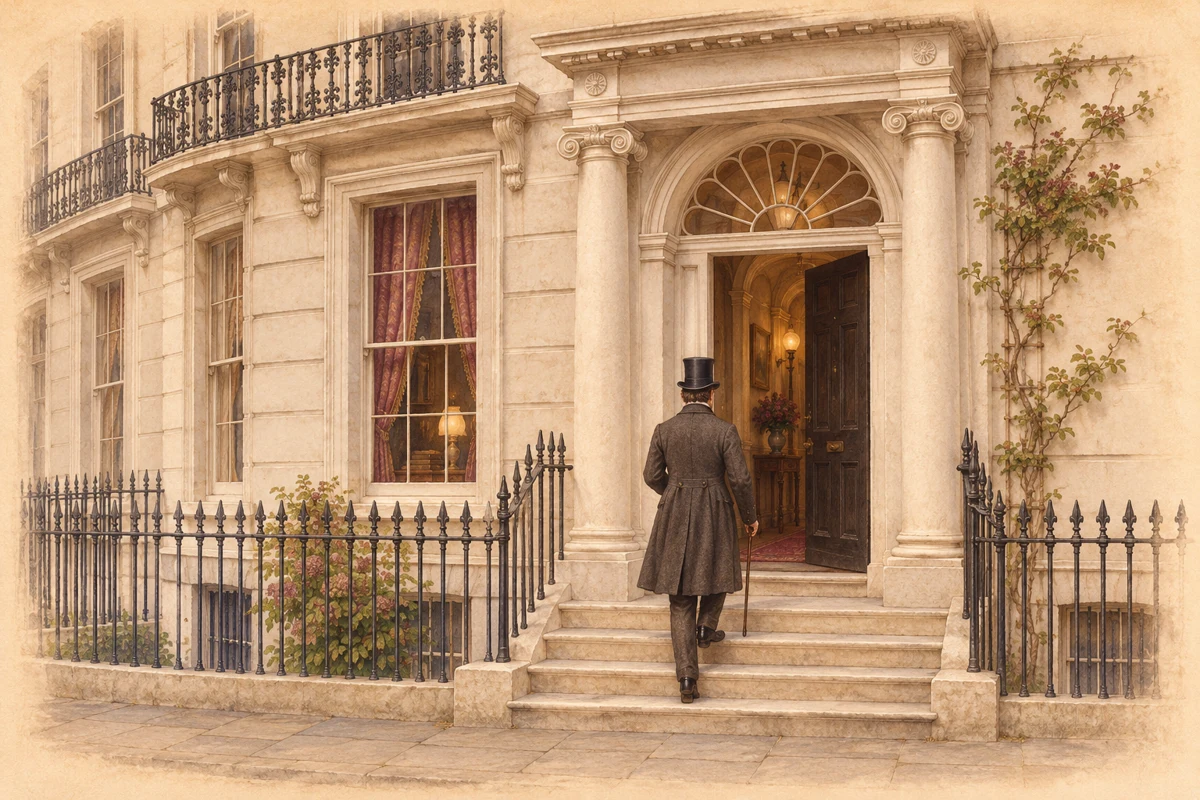
Illustration of a Victorian gentleman entering a London terraced house, viewed from behind
Another day, another life, behind a familiar door.AI-generated period illustration; not an archival photograph.

02 / People behind the doors

Dover Street’s
people and stories.

A few lives that connect this neighbourhood with a much wider story.

John Ayrton Paris

Historical No. 27 Dover Street

John Ayrton Paris is recorded at No. 27 in both directories. His lectures and his book Pharmacologia helped teach physicians how to understand and prescribe medicines. Elected president of the Royal College of Physicians in 1844, he held the office until his death in 1856. The College’s biography confirms his long connection with Dover Street and records that he died at his house here.

Sources and directory references

Selected directory observations: Boyle’s 1836, PDF p. 84 (1836_BG); Boyle’s 1837, PDF p. 84 (1837_BG); Webster’s 1847, PDF p. 66 (1847_WB); Webster’s 1848, PDF p. 77 (1848_WB). Page references are PDF pages. These observations do not establish continuous residence.

James Arthur Wilson

Historical No. 28 Dover Street

At No. 28, the directories identify James Arthur Wilson, a physician at St George’s Hospital from 1829 to 1857. He taught anatomy and lectured on subjects including pain. Writing under the name Maxilla in 1833, he also pressed for reform within the Royal College of Physicians. His work illustrates how a Mayfair medical address could be connected with teaching, hospital practice and debates about the profession itself.

Sources and directory references

Selected directory observations: Boyle’s 1863, PDF p. 108 (1863_BG); Boyle’s 1864, PDF p. 110 (1864_BG); Webster’s 1847, PDF p. 66 (1847_WB); Webster’s 1848, PDF p. 77 (1848_WB). Page references are PDF pages. These observations do not establish continuous residence.

Maude Stanley

No. 40 Dover Street · listed with Lady Stanley of Alderley in 1885 and 1892

Stanley was a pioneer of clubs and social work for working girls. Her Soho Club offered education, recreation and affordable accommodation, and she helped develop the London Union of Girls’ Clubs. Her books described neighbourhood visiting and the organisation of girls’ clubs. She lived with her mother, Lady Stanley of Alderley, at No. 40; the guides name Maude herself as well as the family title.

Sources and directory references

Selected directory observations: Webster’s 1885, printed page 83 (PDF page 157), column 4: 40 Stanley of Al- DERLEY, Dow. Stanley, Hon. Miss Maude; Boyle’s 1892, PDF page 113, column 1: 40 Dow. Lady Stanley of Alderley Hon. Maude Stanley. Page references are PDF pages. These observations do not establish continuous residence.

04 / Keep exploring

More history.
Freely discovered.

These collections are a good place to follow your curiosity. Browse their online records free; copies, downloads or permission to reproduce images may carry a charge.

Streets.London is a project by Infrastructure.London.
More ways we care for London’s homes and gardens.

Your details, thoughtfully handled.

Who we are. Streets.London is a project of London Infrastructure Solutions.

Launch updates. With your consent, we use your email address, optional street and postcode interests, the page where you signed up, and any organisation and property-count details you provide to handle group enquiries and send Streets.London launch and record-availability updates. These details are submitted to Brevo to manage our subscriber list. The optional email-update form does not create an account or purchase anything. Free account registration is separate; see our account privacy notice.

Keeping and removing your details. We keep signup information while it is needed for these updates. You can withdraw consent, ask for a copy or correction, or request deletion using the unsubscribe link in our emails, by replying to an update from us or using the London Infrastructure Solutions contact form. We will stop updates when you withdraw consent.

Services we use. Our hosting provider serves this website. Brevo processes signup details and manages our email updates, while Cloudflare Turnstile checks for automated abuse. These providers may process information outside the UK. We do not sell your signup information.

Analytics. If you allow optional analytics, Google Analytics helps us understand page visits and completed signups. We do not send your form email address, street interest or postcode to Google Analytics. Your cookie choice is stored on this device and can be changed using “Cookie choices”.

Your rights. You may ask us to access, correct or delete your information or withdraw consent. You can also raise a concern with the UK Information Commissioner’s Office at ico.org.uk.

Last updated: 15 November 2026.