01 / Euston and Bloomsbury

Euston Square
History behind the address.

Euston Square history reaches beyond the gardens outside the railway station. The nineteenth-century name embraced houses on both sides of the New Road, renamed Euston Road in 1857. Development on the Southampton estate created a residential neighbourhood that was subsequently transformed by the station and its approaches. The south side became Endsleigh Gardens in 1879, an important distinction when following an address through successive directories.

Later rebuilding changed both the houses and the open spaces. The extension of Euston Grove in 1869 divided the northern gardens, while the expiry of leases on the southern side in 1922 helped make way for Friends House, built in 1925–27. Older photographs and maps therefore tell a rather different story from today’s station frontage. The numbers below are those printed in the historical directories; they should not be transferred automatically to modern buildings.

History sources
Explore its people and history
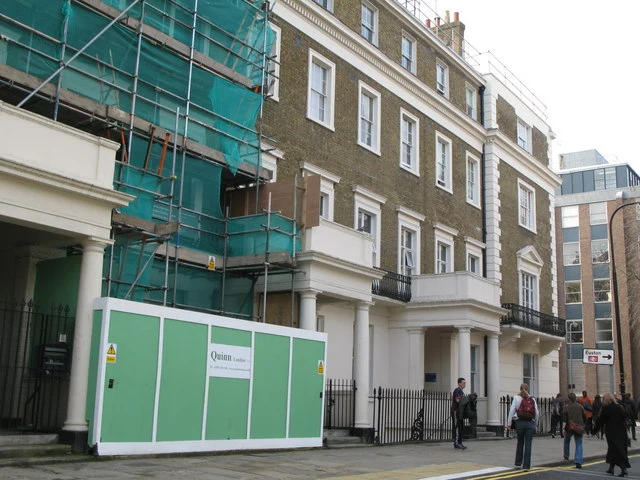
Houses on Endsleigh Gardens, formerly the southern side of Euston Square, photographed in 2009.
Houses on Endsleigh Gardens, formerly the southern side of Euston Square, photographed in 2009. Mike Quinn · Wikimedia Commons · CC BY-SA 2.0 · Converted to WebP for display.

This history is growing. Further directory research and photographs will be added.

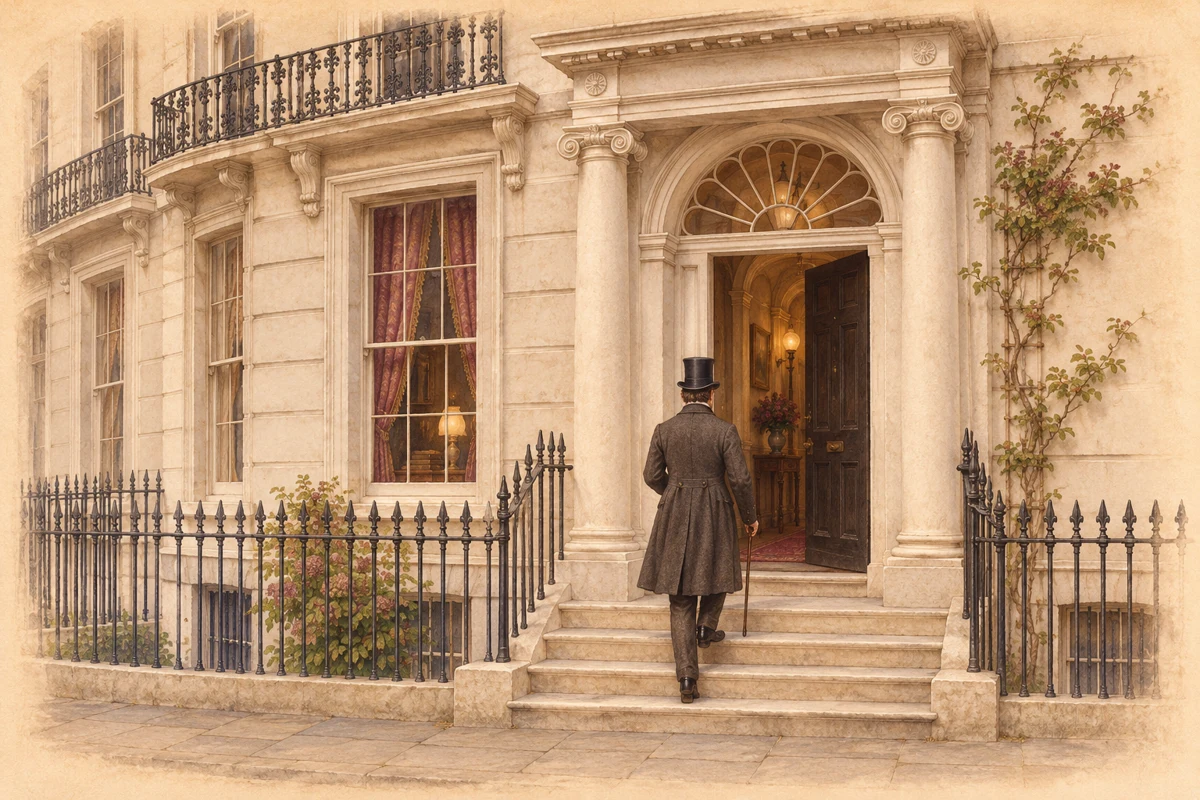
Illustration of a Victorian gentleman entering a London terraced house, viewed from behind
Another day, another life, behind a familiar door.AI-generated period illustration; not an archival photograph.

02 / People behind the doors

Euston Square’s
people and stories.

A few lives that connect this neighbourhood with a much wider story.

Richard Gilbert

Historical No. 70 Euston Square

A directory maker himself appears in the directories at No. 70. Richard Gilbert was a printer, a partner in Gilbert & Rivington, and the compiler of successive editions of the Clerical Guide, which organised information about the Church of England’s clergy. He also produced guides to schools and colleges. His biographical entry independently records his death at 70 Euston Square in February 1852, confirming the address found in both Boyle’s and Webster’s.

Sources and directory references

Selected directory observations: Boyle’s 1825, PDF p. 70 (1825_BG); Boyle’s 1831, PDF p. 79 (1831_BG); Webster’s 1847, PDF p. 73 (1847_WB); Webster’s 1849, PDF p. 86 (1849_WB). Page references are PDF pages. These observations do not establish continuous residence.

Ernest Zuccani

Historical No. 47 Euston Square

Boyle’s and Webster’s list Ernest Zuccani at No. 47. His name connects the square with the elaborate interiors of Victorian houses: the Metropolitan Museum of Art holds a book attributed to him containing designs for chimney decorations, mirrors and console furniture, illustrated with lithographs by Emile-Florentin Daumont. This is a connection with the design and furnishing trades, rather than evidence that any particular surviving Euston house contains his work.

Sources and directory references

Selected directory observations: Boyle’s 1867, PDF p. 128 (1867_BG); Boyle’s 1868, PDF p. 128 (1868_BG); Webster’s 1876, PDF p. 158 (1876_WB); Webster’s 1877, PDF p. 159 (1877_WB). Page references are PDF pages. These observations do not establish continuous residence.

William Michael Rossetti

Historical No. 56 Euston Square · listed in 1868–69

Rossetti was a founding member of the Pre-Raphaelite Brotherhood, its secretary and the editor of its short-lived journal, The Germ. A civil servant by profession, he also became an influential critic and historian of art and literature. His editorial work helped preserve the movement’s story and the writings of his family, including his brother Dante Gabriel and sister Christina. The directories place him at No. 56 in the late 1860s.

Sources and directory references

Selected directory observations: Webster’s 1868, printed page 87 (PDF page 128), column 3: 56 ROSSETTI , Wm . M.; Webster’s 1869, printed page 86 (PDF page 127), column 1: 56 ROSSETTI , Wm . M.. Page references are PDF pages. These observations do not establish continuous residence.

04 / Keep exploring

More history.
Freely discovered.

These collections are a good place to follow your curiosity. Browse their online records free; copies, downloads or permission to reproduce images may carry a charge.

Streets.London is a project by Infrastructure.London.
More ways we care for London’s homes and gardens.

Your details, thoughtfully handled.

Who we are. Streets.London is a project of London Infrastructure Solutions.

Launch updates. With your consent, we use your email address, optional street and postcode interests, the page where you signed up, and any organisation and property-count details you provide to handle group enquiries and send Streets.London launch and record-availability updates. These details are submitted to Brevo to manage our subscriber list. The optional email-update form does not create an account or purchase anything. Free account registration is separate; see our account privacy notice.

Keeping and removing your details. We keep signup information while it is needed for these updates. You can withdraw consent, ask for a copy or correction, or request deletion using the unsubscribe link in our emails, by replying to an update from us or using the London Infrastructure Solutions contact form. We will stop updates when you withdraw consent.

Services we use. Our hosting provider serves this website. Brevo processes signup details and manages our email updates, while Cloudflare Turnstile checks for automated abuse. These providers may process information outside the UK. We do not sell your signup information.

Analytics. If you allow optional analytics, Google Analytics helps us understand page visits and completed signups. We do not send your form email address, street interest or postcode to Google Analytics. Your cookie choice is stored on this device and can be changed using “Cookie choices”.

Your rights. You may ask us to access, correct or delete your information or withdraw consent. You can also raise a concern with the UK Information Commissioner’s Office at ico.org.uk.

Last updated: 15 November 2026.