

01 / Paddington & Bayswater · W2

Gloucester Gardens
History behind the address.

Gloucester Gardens was a terrace on the north side of Bishop’s Road, now Bishop’s Bridge Road, in Paddington. Its historic address belongs to the development around the Great Western Railway: the road was constructed in 1837 across railway and canal land that had formed part of the Bishop of London’s estate. The London Archives describes the terrace as mid nineteenth-century houses of four storeys with basements.

The directories locate Gloucester Gardens beside Westbourne Terrace. Allen’s 1868 street directory places it on Bishop’s Road and records Holy Trinity Church alongside the numbered households. Bishop’s Road became Bishop’s Bridge Road in 1938. The house numbers below are those printed in the historical guides; they should not be assumed to match modern street numbering.

The surviving entries connect neighbouring houses with glasshouse design, cricket publishing, engineering and invention. Burton at No. 37, Pycroft at No. 27, Burgoyne at No. 8 and Hyatt at No. 66 each have a specific guide entry, with further sources explaining the work behind the name.

History sources
Explore its people and history
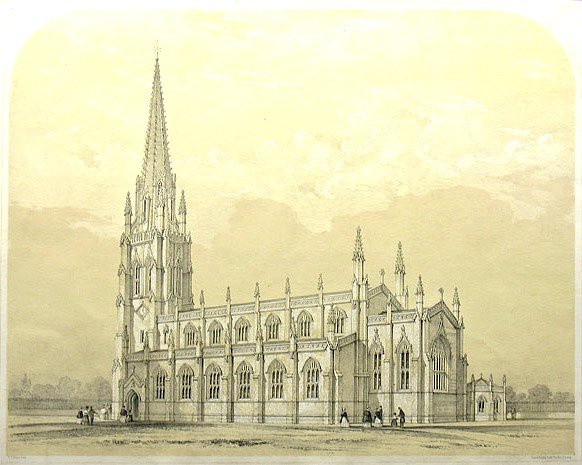
Historic lithograph of Holy Trinity Church on Bishop’s Road, Paddington, by T. Bury
Holy Trinity Church on Bishop’s Road, beside the historic Gloucester Gardens address: a lithograph by T. Bury, published by Day & Haghe. Public domain; Wikimedia Commons. T. Bury; published by Day & Haghe · Public domain; not an archival photograph.

This history is growing. Further directory research and photographs will be added.

Engraved portrait of Thaddeus Hyatt, 1860
Thaddeus Hyatt, in Frank Leslie’s Illustrated Newspaper, 31 March 1860. Public domain; Wikimedia Commons. Frank Leslie’s Illustrated Newspaper · Wikimedia Commons · Public domain

02 / People behind the doors

Gloucester Gardens’s
people and stories.

A few lives that connect this neighbourhood with a much wider story.

Decimus Burton

No. 37 Gloucester Gardens · listed in 1863

Webster’s places architect Decimus Burton at No. 37 in 1863. His work brought together classical architecture and new possibilities in iron and glass: with iron-maker Richard Turner he created Kew’s Palm House, built in 1844–48. Kew commissioned him to design its Temperate House in 1859. The directory connects this London home with an architect whose buildings helped shape the experience of public gardens.

Sources and directory references

Selected directory observations: Webster’s 1863, printed page 85 (PDF page 130), column 3: 37 BURTON, Decimus, archt... Page references are PDF pages. These observations do not establish continuous residence.


James Pycroft

No. 27 Gloucester Gardens · listed in 1863

The clergyman and cricket writer James Pycroft appears at No. 27 in Webster’s 1863 guide. His own correspondence confirms the connection: a letter dated 17 May 1865, catalogued by Christie’s, was sent from 27 Gloucester Gardens and discussed forwarding his book Cricketana. The same collection includes correspondence about editions of The Cricket Field, bringing the practical business of Victorian sports writing into this domestic address.

Sources and directory references

Selected directory observations: Webster’s 1863, printed page 85 (PDF page 130), column 3: 27 PYCROFT, Rev. James.. Page references are PDF pages. These observations do not establish continuous residence.

Thaddeus Hyatt

No. 66 Gloucester Gardens · listed in 1874

Inventor and abolitionist Thaddeus Hyatt is listed at No. 66 in 1874. His Gloucester Gardens address also appears in an 1871 patent notice for improvements to fireproof buildings and their equipment. The pairing of the directory and patent record gives this terrace a place in the history of building technology, while the Smithsonian’s portrait catalogue records his parallel role in the movement against slavery.

Sources and directory references

Selected directory observations: Webster’s 1874, printed page 103 (PDF page 168), column 1: 66 HYATT, Thaddeus.. Page references are PDF pages. These observations do not establish continuous residence.

Sir John Fox Burgoyne

No. 8 Gloucester Gardens · listed in 1868

Webster’s 1868 entry at No. 8 gives Burgoyne’s full name and identifies him as field marshal and Constable of the Tower of London. His career also extended into civil engineering: he chaired Ireland’s Board of Public Works from 1831, worked on the improvement of the Shannon and on railway planning, and became the first president of the Institution of Civil Engineers of Ireland. His address adds public infrastructure to the street’s architectural and inventive connections.

Sources and directory references

Selected directory observations: Webster’s 1868, printed page 96 (PDF page 137), column 2: 8 BURGOYNE, Field-Marshal Sir John Fox, Bart. G.C.B. Constable of the Tower of London.. Page references are PDF pages. These observations do not establish continuous residence.

04 / Keep exploring

More history.
Freely discovered.

These collections are a good place to follow your curiosity. Browse their online records free; copies, downloads or permission to reproduce images may carry a charge.

More nearby streets in the London Picture Archive: Bishop’s Bridge Road

Streets.London is a project by Infrastructure.London.
More ways we care for London’s homes and gardens.

Your details, thoughtfully handled.

Who we are. Streets.London is a project of London Infrastructure Solutions.

Launch updates. With your consent, we use your email address, optional street and postcode interests, the page where you signed up, and any organisation and property-count details you provide to handle group enquiries and send Streets.London launch and record-availability updates. These details are submitted to Brevo to manage our subscriber list. The optional email-update form does not create an account or purchase anything. Free account registration is separate; see our account privacy notice.

Keeping and removing your details. We keep signup information while it is needed for these updates. You can withdraw consent, ask for a copy or correction, or request deletion using the unsubscribe link in our emails, by replying to an update from us or using the London Infrastructure Solutions contact form. We will stop updates when you withdraw consent.

Services we use. Our hosting provider serves this website. Brevo processes signup details and manages our email updates, while Cloudflare Turnstile checks for automated abuse. These providers may process information outside the UK. We do not sell your signup information.

Analytics. If you allow optional analytics, Google Analytics helps us understand page visits and completed signups. We do not send your form email address, street interest or postcode to Google Analytics. Your cookie choice is stored on this device and can be changed using “Cookie choices”.

Your rights. You may ask us to access, correct or delete your information or withdraw consent. You can also raise a concern with the UK Information Commissioner’s Office at ico.org.uk.

Last updated: 15 November 2026.