01 / Soho · W1

Golden Square
History behind the address.

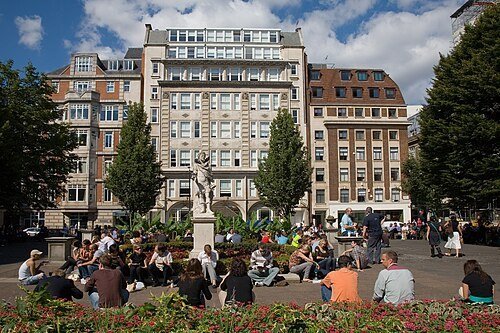
Golden Square developed during the late seventeenth century as London’s residential streets spread westwards. Originally called Goldring Square, it belongs to the early generation of West End squares that placed an open garden among closely grouped houses. Westminster Council records a possible connection with plans by Christopher Wren, although that attribution is uncertain.

The garden gave the surrounding houses a shared outlook and a welcome patch of greenery within an increasingly built-up neighbourhood. Like other London squares, it acquired an enclosed garden during the eighteenth century. Today its public space includes seating, flower displays, rose beds and hornbeam trees. The combination of a planted centre and continuous surrounding frontages preserves the basic arrangement of the earlier residential square.

History sources
Explore its people and history
Golden Square
Golden Square and its garden, photographed by Diliff; Wikimedia Commons, CC BY 2.5. Diliff · Wikimedia Commons · CC BY 2.5

This history is growing. Further directory research and photographs will be added.

Nicolas-Charles Bochsa, portrayed by Peter Copmann in 1837; Wikimedia Commons, public domain.
Nicolas-Charles Bochsa, portrayed by Peter Copmann in 1837; Wikimedia Commons, public domain. Peter Copmann (Danish, 1794 - 1850) · Wikimedia Commons · Public domain

02 / People behind the doors

Golden Square’s
people and stories.

A few lives that connect this neighbourhood with a much wider story.

Nicolas-Charles Bochsa

Historic No. 37 Golden Square · listed in 1829

Bochsa was a French harpist and composer whose international performing career helped establish the harp as a virtuoso concert instrument. His compositions and teaching works added substantially to its repertoire, connecting London’s musical life with developments in European performance.

Sources and directory references

Selected directory observations: Boyle’s 1829, printed page 75 (PDF page 80), column 1: 37 N. C. Bochsa.. Page references are PDF pages. These observations do not establish continuous residence.

Thomas Talbot Bury

Historic No. 26 Golden Square · listed in 1848

Bury combined architecture with lithography and architectural illustration. Trained by Augustus Charles Pugin, he became known for views of the Liverpool and Manchester Railway as well as for his buildings. His work helped record the changing appearance of Britain during the early railway age.

Sources and directory references

Selected directory observations: Webster’s 1848, printed page 87 (PDF page 96), column 1: 26 BURY, T. T. archt... Page references are PDF pages. These observations do not establish continuous residence.

Sir William Bowman

Historic No. 14 Golden Square · listed in 1848

Bowman used microscopy to investigate the structure of human organs, making important contributions to nineteenth-century anatomy. He also became a leading ophthalmic surgeon. His career connected detailed laboratory observation with the development of more specialised medical and surgical practice.

Sources and directory references

Selected directory observations: Webster’s 1848, printed page 86 (PDF page 95), column 4: 14 BOWMAN, W.surg... Page references are PDF pages. These observations do not establish continuous residence.

04 / Keep exploring

More history.
Freely discovered.

These collections are a good place to follow your curiosity. Browse their online records free; copies, downloads or permission to reproduce images may carry a charge.

Streets.London is a project by Infrastructure.London.
More ways we care for London’s homes and gardens.

Your details, thoughtfully handled.

Who we are. Streets.London is a project of London Infrastructure Solutions.

Launch updates. With your consent, we use your email address, optional street and postcode interests, the page where you signed up, and any organisation and property-count details you provide to handle group enquiries and send Streets.London launch and record-availability updates. These details are submitted to Brevo to manage our subscriber list. The optional email-update form does not create an account or purchase anything. Free account registration is separate; see our account privacy notice.

Keeping and removing your details. We keep signup information while it is needed for these updates. You can withdraw consent, ask for a copy or correction, or request deletion using the unsubscribe link in our emails, by replying to an update from us or using the London Infrastructure Solutions contact form. We will stop updates when you withdraw consent.

Services we use. Our hosting provider serves this website. Brevo processes signup details and manages our email updates, while Cloudflare Turnstile checks for automated abuse. These providers may process information outside the UK. We do not sell your signup information.

Analytics. If you allow optional analytics, Google Analytics helps us understand page visits and completed signups. We do not send your form email address, street interest or postcode to Google Analytics. Your cookie choice is stored on this device and can be changed using “Cookie choices”.

Your rights. You may ask us to access, correct or delete your information or withdraw consent. You can also raise a concern with the UK Information Commissioner’s Office at ico.org.uk.

Last updated: 15 November 2026.