

01 / South Kensington · SW7

Harrington Gardens
History behind the address.

Harrington Gardens developed during the 1880s on the northern part of the Gunter Estate. The arrival of the Metropolitan and District railways encouraged housebuilding in the area, helping turn former market-garden land into a network of substantial residential streets.

The communal gardens were provided for lessees of the surrounding houses and, in some cases, neighbours who paid a garden rent. Trees, shrubs and lawns formed the shared landscape behind the architectural display. The surviving ornamental gateway, with its floral decoration, is a small reminder of the attention given to garden entrances as well as house façades.

History sources
Explore its people and history
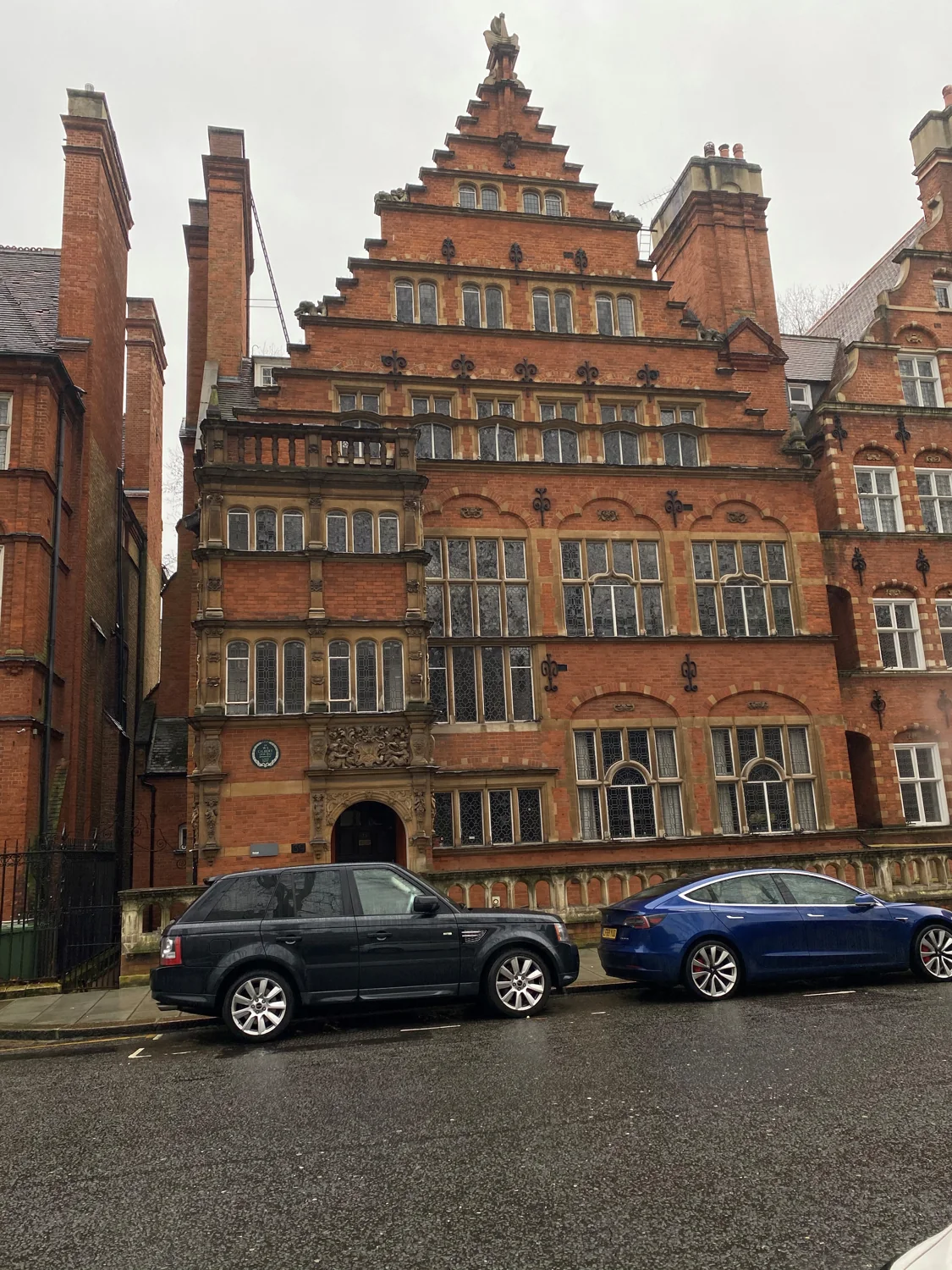
No. 39 Harrington Gardens, associated with W. S. Gilbert.
No. 39 Harrington Gardens, associated with W. S. Gilbert. Damilaville · Wikimedia Commons · CC BY-SA 4.0
W. S. Gilbert, photographed by Elliott & Fry, about 1882–1883.
W. S. Gilbert, photographed by Elliott & Fry, about 1882–1883. Elliott & Fry; restoration by Adam Cuerden; University of Minnesota Library · Wikimedia Commons · Public domain · Resized to fit 1200 × 1600 pixels and converted to JPEG; composition retained.

02 / People behind the doors

Harrington Gardens’s
people and stories.

A few lives that connect this neighbourhood with a much wider story.

W. S. Gilbert

No. 39 Harrington Gardens

The dramatist and librettist lived at No. 39. Both Boyle’s and Webster’s place him at the address, and his blue plaque provides independent confirmation. The house connects this residential street with the theatrical world of Gilbert and Sullivan.

Sources and directory references

Selected directory observations: Boyle’s 1887, p. 163; Webster’s 1889, p. 208. Page references are PDF pages. These observations do not establish continuous residence.


John Anderson

No. 71 Harrington Gardens · listed in 1893

This medically qualified zoologist had been in charge of the Indian Museum in Calcutta from 1865 to 1886. His interests continued after his return to Britain. In 1899 he signed a proposal from 71 Harrington Gardens urging a systematic survey of the fishes of the Nile, seeking Egyptian government support and backing from fellow scientists. The address on that published appeal joins the guide’s formal initials to an active research project, and shows the house as a point of contact in an international scientific network.

Sources and directory references

Selected directory observations: Webster’s 1893, printed page 138 (PDF page 209), column 1: “71 Anderson, John, M.D., LL.D., F.R.S.”.. Page references are PDF pages. These observations do not establish continuous residence.
Margaret Piper-Riekmann

Nos. 5 and 7 Harrington Gardens · listed in 1903 and 1907

Piper-Riekmann wrote The Swedish Movement Cure, advocating the system of therapeutic exercises associated with the Swedish educator Pehr Henrik Ling. Her book’s preface, dated September 1896 at No. 5 Harrington Gardens, argues that medical gymnastics deserved recognition beyond massage alone. The later directories name her at Nos. 5 and 7. Her work brings a woman’s contribution to the history of physical treatment into the street’s story.

Sources and directory references

Selected directory observations: Webster’s 1903, printed page 149 (PDF page 218), column 4: 5 & 7 RICKMANN, Mdme. PIPER-; Royal Blue Book 1907, printed page 317 (PDF page 356), column 3: 5 & 7 Riekmann, Mdme. Margaret Piper-. Page references are PDF pages. These observations do not establish continuous residence.

04 / Keep exploring

More history.
Freely discovered.

These collections are a good place to follow your curiosity. Browse their online records free; copies, downloads or permission to reproduce images may carry a charge.

Streets.London is a project by Infrastructure.London.
More ways we care for London’s homes and gardens.

Your details, thoughtfully handled.

Who we are. Streets.London is a project of London Infrastructure Solutions.

Launch updates. With your consent, we use your email address, optional street and postcode interests, the page where you signed up, and any organisation and property-count details you provide to handle group enquiries and send Streets.London launch and record-availability updates. These details are submitted to Brevo to manage our subscriber list. The optional email-update form does not create an account or purchase anything. Free account registration is separate; see our account privacy notice.

Keeping and removing your details. We keep signup information while it is needed for these updates. You can withdraw consent, ask for a copy or correction, or request deletion using the unsubscribe link in our emails, by replying to an update from us or using the London Infrastructure Solutions contact form. We will stop updates when you withdraw consent.

Services we use. Our hosting provider serves this website. Brevo processes signup details and manages our email updates, while Cloudflare Turnstile checks for automated abuse. These providers may process information outside the UK. We do not sell your signup information.

Analytics. If you allow optional analytics, Google Analytics helps us understand page visits and completed signups. We do not send your form email address, street interest or postcode to Google Analytics. Your cookie choice is stored on this device and can be changed using “Cookie choices”.

Your rights. You may ask us to access, correct or delete your information or withdraw consent. You can also raise a concern with the UK Information Commissioner’s Office at ico.org.uk.

Last updated: 15 November 2026.