01 / Marylebone, Westminster

Marylebone Lane
History behind the address.

Marylebone Lane preserves an older pattern within the straight streets laid out around it. Its bends and angled junctions recall the landscape of the Tyburn brook and the village that preceded Georgian Marylebone. At the Oxford Street end the lane divides around an island of buildings, close to the site of the medieval parish church. The parish’s religious centre moved north in the early fifteenth century, but this southern site later became an administrative centre for the district.

The lane’s character comes from its varied building plots and short views. Narrow shopfronts, public houses and entrances to upper floors sit beside later commercial buildings, while wider cross streets briefly open the view before the lane bends again. At Nos. 33–35, nineteenth-century stuccoed houses retain ornamented sash windows and mansard roofs above their shops. This mixture of small premises and residential upper storeys gives the lane a distinct scale beside Oxford Street and the more regular streets of Marylebone.

History sources
Explore its people and history
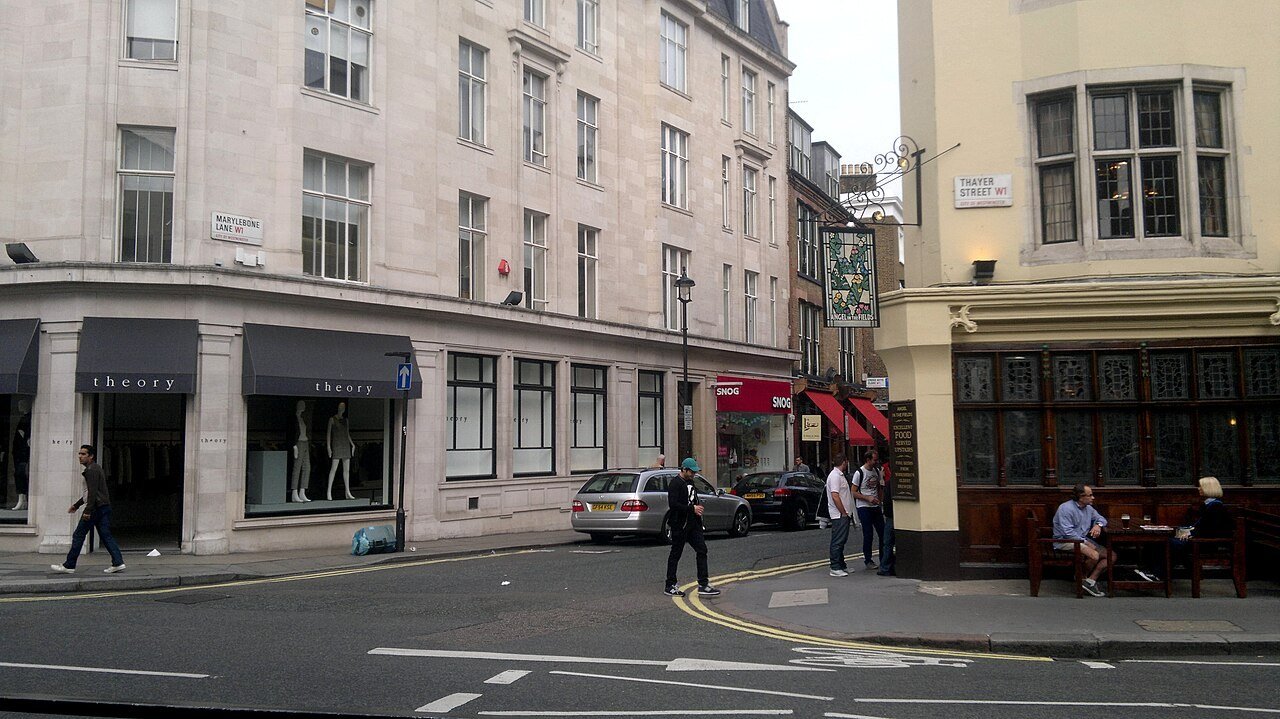
Marylebone Lane at Thayer Street, photographed on 6 September 2014.
Marylebone Lane at Thayer Street, photographed on 6 September 2014. Philafrenzy · Wikimedia Commons · CC BY-SA 4.0 · Resized for display; no content changes

This history is growing. Further directory research and photographs will be added.

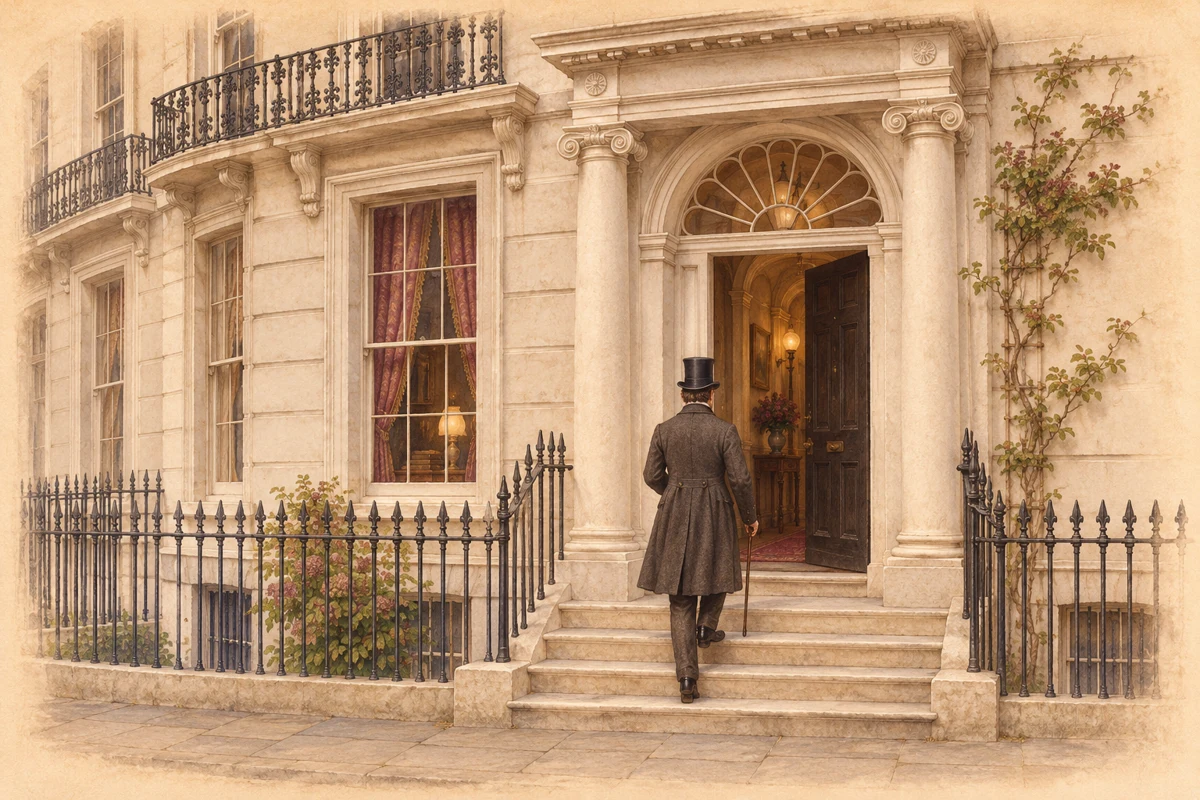
Illustration of a Victorian gentleman entering a London terraced house, viewed from behind
Another day, another life, behind a familiar door.AI-generated period illustration; not an archival photograph.

02 / People behind the doors

Marylebone Lane’s
people and stories.

A few lives that connect this neighbourhood with a much wider story.

Paul Rothe

No. 35 Marylebone Lane · listed in 1914

Paul Rothe is listed at No. 35 as a provision dealer. The family business dates its arrival in Marylebone to 2 August 1900. This directory entry supplies an early address connection for the delicatessen that became one of the lane’s enduring shops.

Sources and directory references

Selected directory observations: Kelly’s Post Office London Directory, 1914, PDF p. 336, col. 3. Page references are PDF pages. These observations do not establish continuous residence.

Mary Jane Dalton

No. 25 Marylebone Lane · listed in 1895

Mrs Mary Jane Dalton is recorded at No. 25 with coffee rooms. Her entry identifies a woman providing meals and refreshments in the lane, adding a personal name to the everyday places used by its workers, shoppers and neighbours.

Sources and directory references

Selected directory observations: Kelly’s Post Office London Directory, 1895, PDF p. 364, col. 2. Page references are PDF pages. These observations do not establish continuous residence.

Emma Mortimer

No. 71 Marylebone Lane · listed in 1910, 1914 and 1915

Mrs Emma Mortimer appears at No. 71 with dining rooms in three allowed editions. The repeated address gives a clear connection between her name and the lane’s food businesses in the years before and during the First World War.

Sources and directory references

Selected directory observations: Kelly’s Post Office London Directory, 1910, PDF p. 331, col. 4; Kelly’s Post Office London Directory, 1914, PDF p. 336, col. 4; Kelly’s Post Office London Directory, 1915, PDF p. 337, col. 1. Page references are PDF pages. These observations do not establish continuous residence.

Samuel Foxall

No. 116 Marylebone Lane in 1882; Nos. 114–116 in 1895

Samuel Foxall is listed as a maker of copper and tin moulds at No. 116 in 1882 and Nos. 114–116 in 1895. His specialised metalworking trade adds a workshop history to a lane now strongly associated with food shops and cafés.

Sources and directory references

Selected directory observations: Kelly’s Post Office London Directory, 1882, PDF p. 489, col. 3; Kelly’s Post Office London Directory, 1895, PDF p. 364, col. 2. Page references are PDF pages. These observations do not establish continuous residence.

David Penton

No. 14 Marylebone Lane · listed in 1847, using that edition’s numbering

David Penton is recorded at No. 14 as a currier, a worker who dressed and finished leather. His listing places a specialised material trade in the early-Victorian lane and supplies an exact historical address in the numbering used by the 1847 directory.

Sources and directory references

Selected directory observations: Kelly’s Post Office London Directory, 1847, PDF p. 379, col. 3. Page references are PDF pages. These observations do not establish continuous residence.

04 / Keep exploring

More history.
Freely discovered.

These collections are a good place to follow your curiosity. Browse their online records free; copies, downloads or permission to reproduce images may carry a charge.

Streets.London is a project by Infrastructure.London.
More ways we care for London’s homes and gardens.

Your details, thoughtfully handled.

Who we are. Streets.London is a project of London Infrastructure Solutions.

Launch updates. With your consent, we use your email address, optional street and postcode interests, the page where you signed up, and any organisation and property-count details you provide to handle group enquiries and send Streets.London launch and record-availability updates. These details are submitted to Brevo to manage our subscriber list. The optional email-update form does not create an account or purchase anything. Free account registration is separate; see our account privacy notice.

Keeping and removing your details. We keep signup information while it is needed for these updates. You can withdraw consent, ask for a copy or correction, or request deletion using the unsubscribe link in our emails, by replying to an update from us or using the London Infrastructure Solutions contact form. We will stop updates when you withdraw consent.

Services we use. Our hosting provider serves this website. Brevo processes signup details and manages our email updates, while Cloudflare Turnstile checks for automated abuse. These providers may process information outside the UK. We do not sell your signup information.

Analytics. If you allow optional analytics, Google Analytics helps us understand page visits and completed signups. We do not send your form email address, street interest or postcode to Google Analytics. Your cookie choice is stored on this device and can be changed using “Cookie choices”.

Your rights. You may ask us to access, correct or delete your information or withdraw consent. You can also raise a concern with the UK Information Commissioner’s Office at ico.org.uk.

Last updated: 15 November 2026.