01 / Bayswater · W2

Monmouth Road
History behind the address.

Monmouth Road runs through the streets just north of Westbourne Grove, where nineteenth-century development gradually replaced the open land on London’s western edge. Cottages and paired villas were present by the 1840s, followed by a denser urban neighbourhood. Its scale is more intimate than the great stucco boulevards farther east: varied house fronts, smaller plots and local institutions give the road a quieter residential character close to the shops and traffic of Westbourne Grove.

The wider Bayswater district grew through the building of terraces, crescents and garden squares, with later additions filling the spaces between them. Monmouth Road reflects that continuing adaptation rather than a single monumental scheme. Older domestic buildings stand beside altered premises and community uses, while trees soften parts of the frontage. The contrast between this smaller street and its busy surroundings helps explain how Bayswater accommodated both private homes and the everyday services of an expanding population.

History sources
Explore its people and history
Kingdom Hall and neighbouring frontage on Monmouth Road, Bayswater; David Anstiss, Geograph via Wikimedia Commons, CC BY-SA 2.0.
Kingdom Hall and neighbouring frontage on Monmouth Road, Bayswater; David Anstiss, Geograph via Wikimedia Commons, CC BY-SA 2.0. David Anstiss · Wikimedia Commons · CC BY-SA 2.0

This history is growing. Further directory research and photographs will be added.

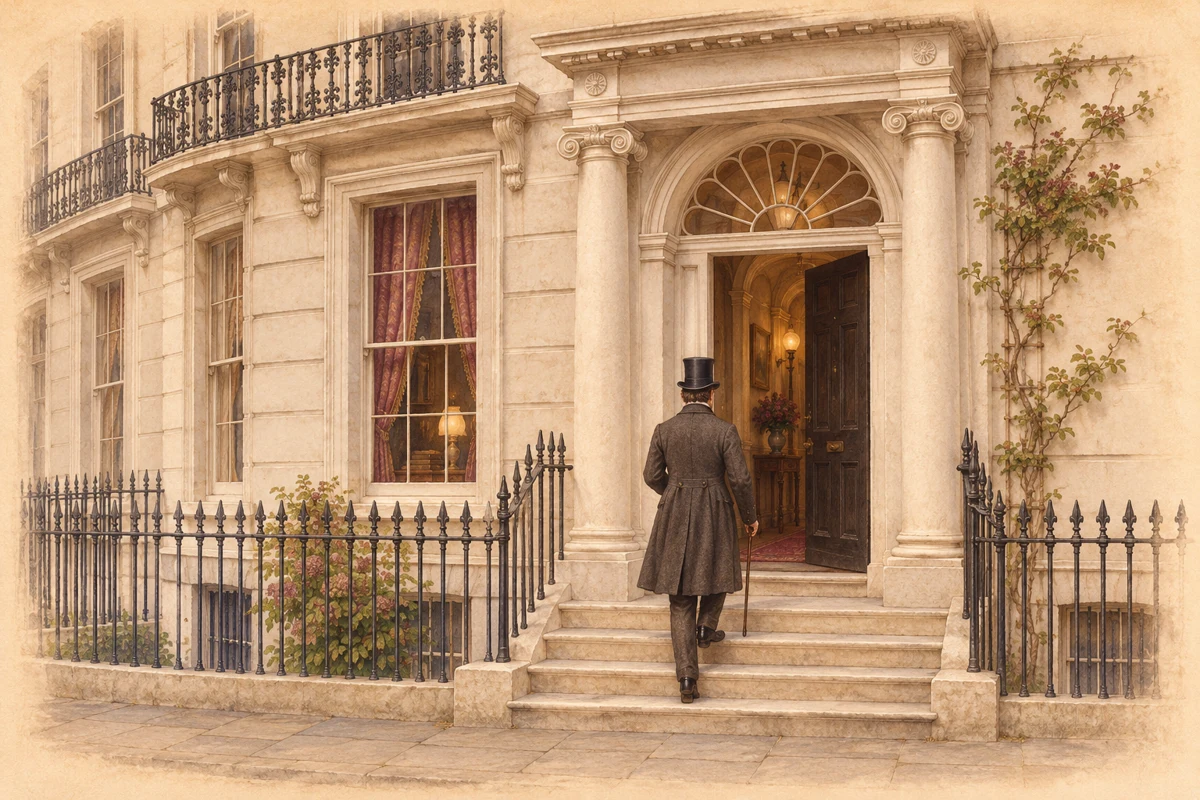
Illustration of a Victorian gentleman entering a London terraced house, viewed from behind
Another day, another life, behind a familiar door.AI-generated period illustration; not an archival photograph.

02 / People behind the doors

Monmouth Road’s
people and stories.

A few lives that connect this neighbourhood with a much wider story.

William Richard Bexfield

No. 12 Monmouth Road · listed as a doctor of music in 1852–53

Bexfield was an organist and composer whose oratorio Israel Restored was performed at the Norwich Musical Festival. He also wrote church music and organ works. His career was cut short by his death in 1853, aged twenty-nine. The directories identify his musical qualification as well as his initials at No. 12.

Sources and directory references

Selected directory observations: Webster’s 1852, printed page 104 (PDF page 149), column 1: 12 BEXFIELD, W. R. Dr. ofmusic; Webster’s 1853, printed page 104 (PDF page 149), column 4: 12 BEXFIELD,W. R.Dr. ofmusic. Page references are PDF pages. These observations do not establish continuous residence.

John Alfred Vinter

No. 18 Monmouth Road · listed as an artist in 1862–63

Vinter was a painter and lithographer whose portraits and reproductions circulated widely in Victorian Britain. His work connected the exhibition world with the expanding market for printed images. The directories explicitly describe him as an artist at No. 18; later editions record J. A. Vinter at No. 29 on the same road.

Sources and directory references

Selected directory observations: Webster’s 1862, printed page 134 (PDF page 189), column 2: 18 VINTER, JohnA. art.; Webster’s 1863, printed page 134 (PDF page 179), column 2: 18 VINTER, John A. art.. Page references are PDF pages. These observations do not establish continuous residence.

George Edward Hendry

No. 29 Monmouth Road

Hendry was a portrait painter whose surviving work includes a likeness of the American contralto Belle Cole. That painting connects his practice with the concert world of the late Victorian period.

Sources and directory references

Selected directory observations: Royal Blue Book 1907, printed page 385 (PDF page 424), column 2: 29 Hendry, Geo. Edwd. art. Page references are PDF pages. These observations do not establish continuous residence.

04 / Keep exploring

More history.
Freely discovered.

These collections are a good place to follow your curiosity. Browse their online records free; copies, downloads or permission to reproduce images may carry a charge.

Streets.London is a project by Infrastructure.London.
More ways we care for London’s homes and gardens.

Your details, thoughtfully handled.

Who we are. Streets.London is a project of London Infrastructure Solutions.

Launch updates. With your consent, we use your email address, optional street and postcode interests, the page where you signed up, and any organisation and property-count details you provide to handle group enquiries and send Streets.London launch and record-availability updates. These details are submitted to Brevo to manage our subscriber list. The optional email-update form does not create an account or purchase anything. Free account registration is separate; see our account privacy notice.

Keeping and removing your details. We keep signup information while it is needed for these updates. You can withdraw consent, ask for a copy or correction, or request deletion using the unsubscribe link in our emails, by replying to an update from us or using the London Infrastructure Solutions contact form. We will stop updates when you withdraw consent.

Services we use. Our hosting provider serves this website. Brevo processes signup details and manages our email updates, while Cloudflare Turnstile checks for automated abuse. These providers may process information outside the UK. We do not sell your signup information.

Analytics. If you allow optional analytics, Google Analytics helps us understand page visits and completed signups. We do not send your form email address, street interest or postcode to Google Analytics. Your cookie choice is stored on this device and can be changed using “Cookie choices”.

Your rights. You may ask us to access, correct or delete your information or withdraw consent. You can also raise a concern with the UK Information Commissioner’s Office at ico.org.uk.

Last updated: 15 November 2026.