

01 / Bloomsbury · WC1

Montague Place
History behind the address.

Montague Place history is closely entwined with the expansion of the British Museum. Historic England’s study of Nos. 1–2 records that the south side once contained a terrace dating from about 1810. Most of those houses were demolished in 1904 for the King Edward VII Galleries. The remaining pair survived longer, but an attempted refurbishment in the 1960s ended in demolition; a new photographic laboratory reproduced their façades in 1970–73.

The museum’s working buildings tell another part of the story. A purpose-built bindery, constructed in 1898, served the British Museum Library and later the British Library. Nearby households belonged to a broader intellectual neighbourhood of medicine, journalism and scholarship. The directory profiles below use historical numbers in Montague Place by Russell Square, not similarly named streets in Marylebone, and do not imply that the original houses remain intact.

History sources
Explore its people and history
Illustrated London terraces emerging from an open book; a general London illustration, not a view of Montague Place
A London story begins with an address. A photograph of Montague Place will follow. Streets.London · AI-generated illustration; not an archival photograph.

This history is growing. Further directory research and photographs will be added.

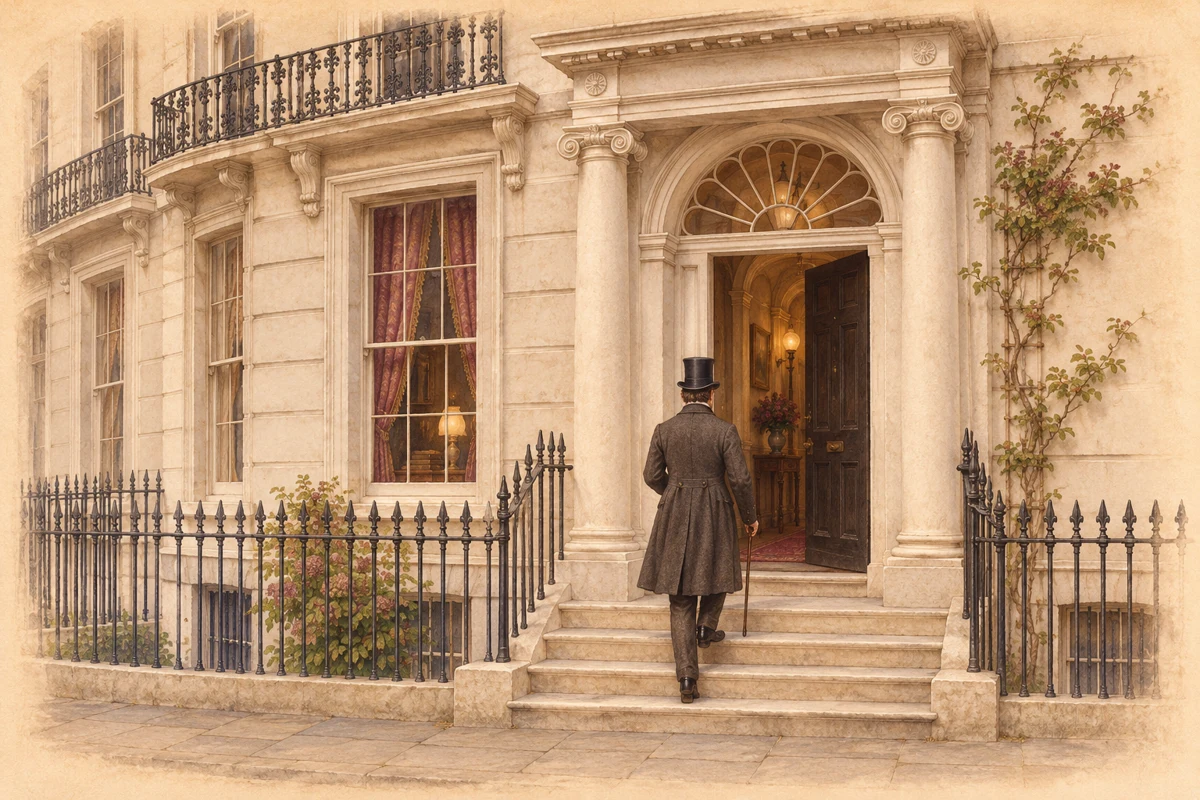
Illustration of a Victorian gentleman entering a London terraced house, viewed from behind
Another day, another life, behind a familiar door.AI-generated period illustration; not an archival photograph.

02 / People behind the doors

Montague Place’s
people and stories.

A few lives that connect this neighbourhood with a much wider story.

Edwin Canton

Historical No. 30 Montague Place · surgeon’s address

Edwin Canton at No. 30 was a surgeon and anatomy lecturer at Charing Cross Hospital. A testimonial he wrote for John Struthers on 22 June 1863 carries the full address, 30 Montague Place, Russell Square, and independently identifies the man in the guides. Canton was also a prolific medical writer. His 1863 book on arcus senilis, a change in the cornea, grew out of work published in The Lancet. An additional archival trace records the Royal Society thanking him in 1855 for letters by Franklin, Priestley and Banks, linking his medical career with the preservation of scientific correspondence.

Sources and directory references

Selected directory observations: Boyle’s 1863, PDF p. 198 (1863_BG); Boyle’s 1866, PDF p. 199 (1866_BG); Webster’s 1877, PDF p. 230 (1877_WB); Webster’s 1880, PDF p. 235 (1880_WB). Page references are PDF pages. These observations do not establish continuous residence.


James Richard Thursfield

Historical No. 11 Montague Place · home

The J. R. Thursfield at No. 11 was James Richard Thursfield, the journalist and naval historian. His biography in the Oxford Dictionary of National Biography independently places him at 11 Montague Place when he married in 1880. After leaving his Oxford fellowship he joined The Times as a leader writer, where he retained a marked independence of judgement. His later papers, preserved at Royal Museums Greenwich, include correspondence with Admiral Sir John Fisher and reports on naval manoeuvres. The directories connect this household with a writer whose influence extended from Bloomsbury into debates about the Royal Navy.

Sources and directory references

Selected directory observations: Boyle’s 1880, PDF p. 209 (1880_BG); Boyle’s 1887, PDF p. 210 (1887_BG); Webster’s 1880, PDF p. 235 (1880_WB); Webster’s 1881, PDF p. 235 (1881_WB). Page references are PDF pages. These observations do not establish continuous residence.
Sir Charles Thomas Newton

No. 2 Montague Place · listed in Webster’s in 1885–86

Newton was an archaeologist whose excavations at ancient Halicarnassus uncovered remains of the Mausoleum, one of the Seven Wonders of the ancient world. He became the British Museum’s Keeper of Greek and Roman Antiquities in 1861. His work helped shape the collections just across the street from his Montague Place address. Successive Webster editions give his full name at No. 2.

Sources and directory references

Selected directory observations: Webster’s 1885, PDF page 247, column 2: 2 Newton, Charles Thomas; Webster’s 1886, printed page 173 (PDF page 248), column 2: 2 NEWTON, Charles Thomas. Page references are PDF pages. These observations do not establish continuous residence.

04 / Keep exploring

More history.
Freely discovered.

These collections are a good place to follow your curiosity. Browse their online records free; copies, downloads or permission to reproduce images may carry a charge.

Streets.London is a project by Infrastructure.London.
More ways we care for London’s homes and gardens.

Your details, thoughtfully handled.

Who we are. Streets.London is a project of London Infrastructure Solutions.

Launch updates. With your consent, we use your email address, optional street and postcode interests, the page where you signed up, and any organisation and property-count details you provide to handle group enquiries and send Streets.London launch and record-availability updates. These details are submitted to Brevo to manage our subscriber list. The optional email-update form does not create an account or purchase anything. Free account registration is separate; see our account privacy notice.

Keeping and removing your details. We keep signup information while it is needed for these updates. You can withdraw consent, ask for a copy or correction, or request deletion using the unsubscribe link in our emails, by replying to an update from us or using the London Infrastructure Solutions contact form. We will stop updates when you withdraw consent.

Services we use. Our hosting provider serves this website. Brevo processes signup details and manages our email updates, while Cloudflare Turnstile checks for automated abuse. These providers may process information outside the UK. We do not sell your signup information.

Analytics. If you allow optional analytics, Google Analytics helps us understand page visits and completed signups. We do not send your form email address, street interest or postcode to Google Analytics. Your cookie choice is stored on this device and can be changed using “Cookie choices”.

Your rights. You may ask us to access, correct or delete your information or withdraw consent. You can also raise a concern with the UK Information Commissioner’s Office at ico.org.uk.

Last updated: 15 November 2026.