
01 / Kensington & Notting Hill

Notting Hill Gate
History behind the address.

Notting Hill Gate takes its name from the toll barriers that once controlled the westward road out of London. The last gate was removed in 1864, but its name survived as the roadside settlement grew into a substantial shopping centre. Victorian terraces and side streets spread north and south from the main route, connecting it with the Ladbroke estate, Campden Hill and the smaller houses of Hillgate Village.

Road widening and redevelopment in the late 1950s changed the main frontage considerably. New shops and larger buildings replaced much of the earlier streetscape, while the formerly separate Underground stations were brought together beneath the road. The contrast remains striking: a broad, busy commercial route gives way within a short walk to narrow residential streets. Surviving entertainment venues and older buildings help retain a sense of the district that preceded this rebuilding.

History sources
Explore its people and history
Notting Hill Gate, showing the broad main road and later shopping frontage.
Notting Hill Gate, showing the broad main road and later shopping frontage. N Chadwick · Wikimedia Commons · CC BY-SA 2.0

This history is growing. Further directory research and photographs will be added.

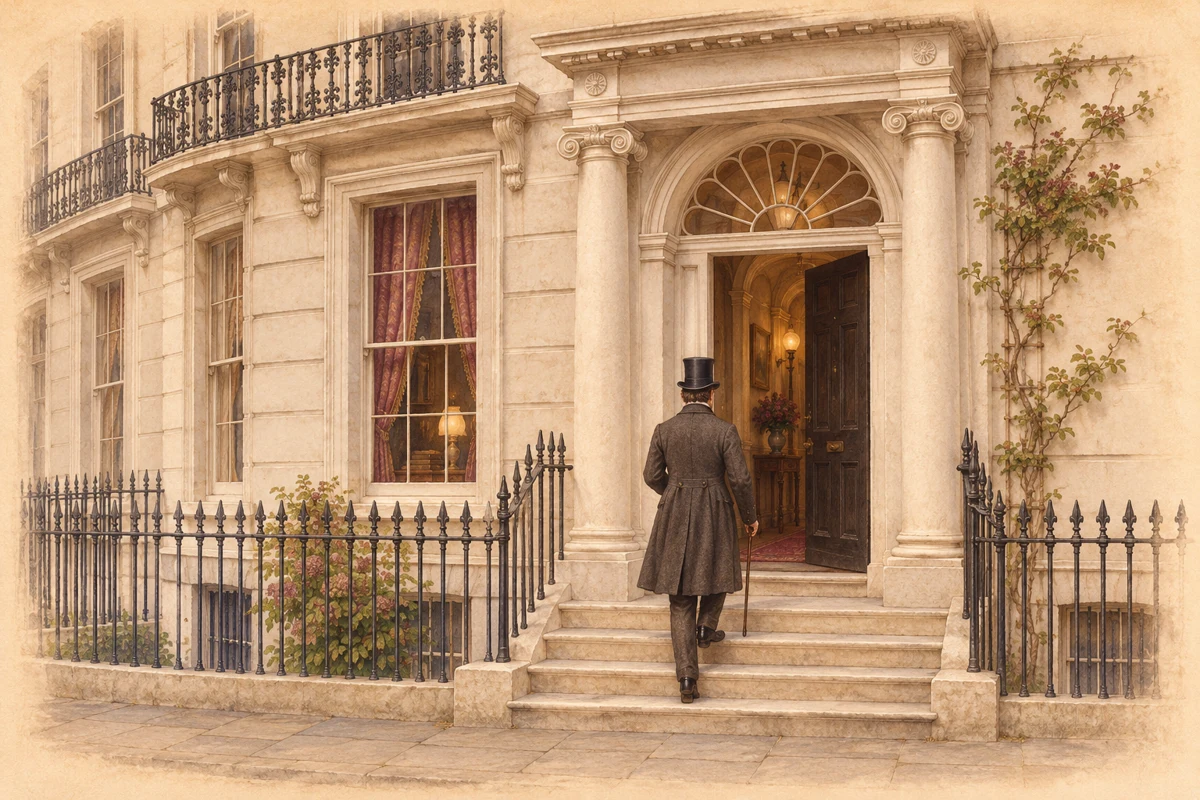
Illustration of a Victorian gentleman entering a London terraced house, viewed from behind
Another day, another life, behind a familiar door.AI-generated period illustration; not an archival photograph.

02 / People behind the doors

Notting Hill Gate’s
people and stories.

A few lives that connect this neighbourhood with a much wider story.

Amy Sandheim

Historical No. 130 High Street, Notting Hill · listed in 1915

Amy Sandheim was an Arts and Crafts jeweller whose work was sold as “Artistic & Peasant Jewellery”. Kelly’s lists her at No. 130 in 1915. Born Amy Alice Wilkins, she trained at the Central School of Art and married Julius Sandheim. Her surviving jewellery and its labelled boxes connect this busy shopping street with a distinctive strand of twentieth-century design.

Sources and directory references

Selected directory observations: Kelly’s Post Office Directory 1915, PDF page 254, column 2: 130, Mrs Amy Sandheim, jeweller. Page references are PDF pages. These observations do not establish continuous residence.


Georgina Wilson

Historical No. 50 High Street, Notting Hill · listed in 1915

Georgina Wilson was listed as a corset maker at No. 50. Her named business belongs to the street’s wider history of clothing trades, alongside dressmakers, milliners and tailors. The directory records her specialist occupation at a precise address.

Sources and directory references

Selected directory observations: Kelly’s Post Office Directory 1915, PDF page 254, column 2: 50, Madame Georgina Wilson, corset maker. Page references are PDF pages. These observations do not establish continuous residence.
George James Glaisher

Historical No. 58 High Street, Notting Hill · listed in 1915

George James Glaisher was a bookseller at No. 58. His shop placed books among the everyday goods and services offered along the main road. Kelly’s gives both his full name and occupation, preserving an individual business behind the changing shopfronts.

Sources and directory references

Selected directory observations: Kelly’s Post Office Directory 1915, PDF page 254, column 2: 58, George James Glaisher, bookseller. Page references are PDF pages. These observations do not establish continuous residence.

04 / Keep exploring

More history.
Freely discovered.

These collections are a good place to follow your curiosity. Browse their online records free; copies, downloads or permission to reproduce images may carry a charge.

Streets.London is a project by Infrastructure.London.
More ways we care for London’s homes and gardens.

Your details, thoughtfully handled.

Who we are. Streets.London is a project of London Infrastructure Solutions.

Launch updates. With your consent, we use your email address, optional street and postcode interests, the page where you signed up, and any organisation and property-count details you provide to handle group enquiries and send Streets.London launch and record-availability updates. These details are submitted to Brevo to manage our subscriber list. The optional email-update form does not create an account or purchase anything. Free account registration is separate; see our account privacy notice.

Keeping and removing your details. We keep signup information while it is needed for these updates. You can withdraw consent, ask for a copy or correction, or request deletion using the unsubscribe link in our emails, by replying to an update from us or using the London Infrastructure Solutions contact form. We will stop updates when you withdraw consent.

Services we use. Our hosting provider serves this website. Brevo processes signup details and manages our email updates, while Cloudflare Turnstile checks for automated abuse. These providers may process information outside the UK. We do not sell your signup information.

Analytics. If you allow optional analytics, Google Analytics helps us understand page visits and completed signups. We do not send your form email address, street interest or postcode to Google Analytics. Your cookie choice is stored on this device and can be changed using “Cookie choices”.

Your rights. You may ask us to access, correct or delete your information or withdraw consent. You can also raise a concern with the UK Information Commissioner’s Office at ico.org.uk.

Last updated: 15 November 2026.