01 / Paddington & Hyde Park · W2

Oxford Terrace
History behind the address.

Oxford Terrace was the name used for the houses on the south side of the broad Paddington thoroughfare now called Sussex Gardens. Cambridge Terrace occupied the opposite side. Westminster’s historical inventory explicitly records the Oxford Terrace enclosures under their later Sussex Gardens name.

The roadway itself was known as Grand Junction Road until 1938. Its separate terrace names are therefore essential when reading nineteenth-century addresses: Oxford Terrace was a particular frontage, rather than a different district. Historical house numbers also need care and should not be assumed to match today’s Sussex Gardens numbering.

History sources
Explore its people and history
Sussex Gardens, the modern street incorporating Oxford Terrace.
Sussex Gardens, the modern street incorporating Oxford Terrace. A Terraced row, Sussex Gardens by N Chadwick · Wikimedia Commons · CC BY-SA 2.0 · Resized and converted to WebP for display.

This history is growing. Further directory research and photographs will be added.

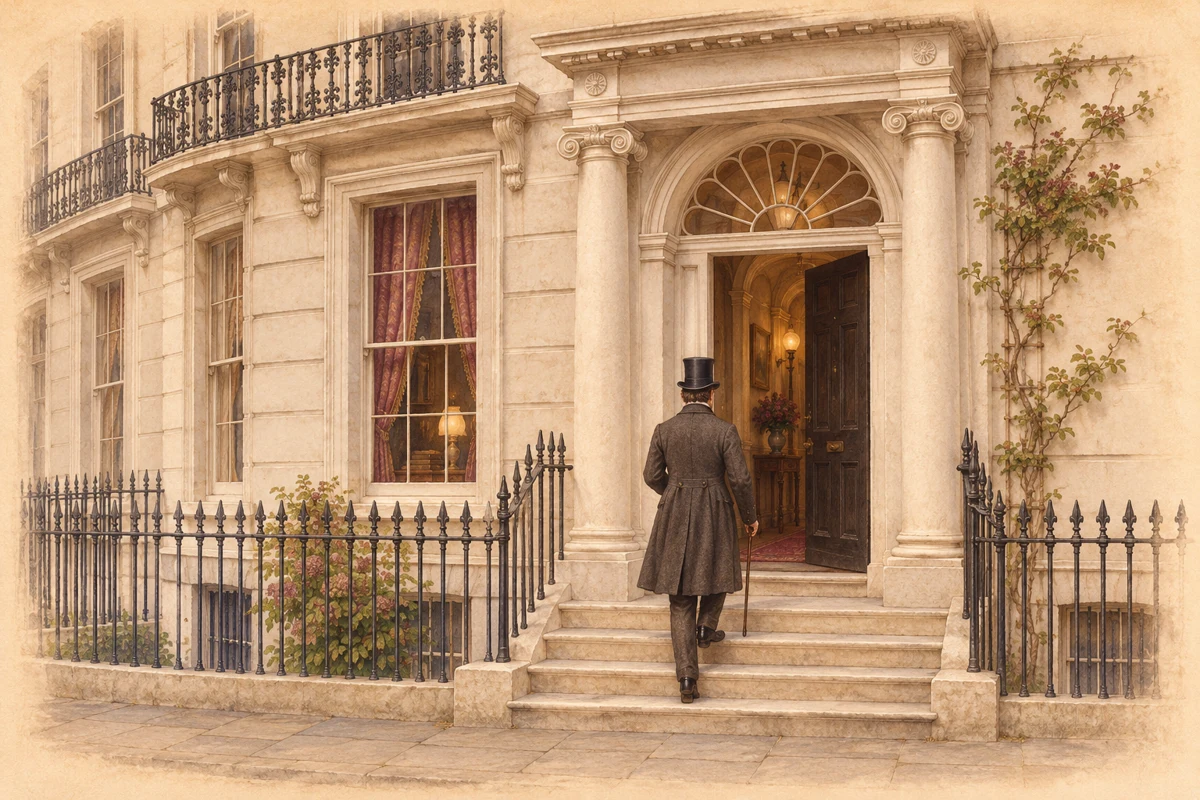
Illustration of a Victorian gentleman entering a London terraced house, viewed from behind
Another day, another life, behind a familiar door.AI-generated period illustration; not an archival photograph.

02 / People behind the doors

Oxford Terrace’s
people and stories.

A few lives that connect this neighbourhood with a much wider story.

Septimus Gibbon

Historical No. 39 Oxford Terrace

Both directories record Dr Gibbon at historical No. 39. His contemporary obituary confirms that he settled there in 1867. A London Hospital physician and long-serving medical officer of health for Holborn, he combined hospital medicine with the public-health work of a rapidly growing city.

Sources and directory references

Selected directory observations: Boyle’s 1874, PDF p. 220 (1874_BG); Boyle’s 1875, PDF p. 222 (1875_BG); Webster’s 1876, PDF p. 244 (1876_WB); Webster’s 1877, PDF p. 246 (1877_WB). Page references are PDF pages. These observations do not establish continuous residence.

Alexander Dyce

Historical No. 33 Oxford Terrace · listed as the Rev. A. Dyce in 1862–63

Dyce was a literary scholar and editor whose publications included editions of Shakespeare and Beaumont and Fletcher. His extensive collection of books, pictures and drawings passed to the South Kensington Museum, now the V&A, after his death in 1869. The museum’s account identifies No. 33 Oxford Terrace as his final home, independently confirming the directory entries.

Sources and directory references

Selected directory observations: Webster’s 1862, printed page 149 (PDF page 204), column 2: 33 DYCE, Rev.A.; Webster’s 1863, printed page 149 (PDF page 194), column 2: 33 DYCE, Rev.A.. Page references are PDF pages. These observations do not establish continuous residence.

Henry Richmond Droop

Historical No. 37 Oxford Terrace · listed as Henry Richmond Droop, barrister, in 1880–81

Droop was a barrister and writer on electoral systems whose name survives in the Droop quota, a method of calculating the votes needed to win a seat in proportional elections. He developed the quota in the 1860s and published On Methods of Electing Representatives in 1881. Boyle’s gives his full name and profession at No. 37, distinguishing him from the abbreviated and inconsistent names in some other editions.

Sources and directory references

Selected directory observations: Boyle’s 1880, PDF page 220, column 1: 37 Henry Richmond Droop, bar.; Boyle’s 1881, PDF page 203, column 2: 37 Henry RichmondDroop, bar.. Page references are PDF pages. These observations do not establish continuous residence.

04 / Keep exploring

More history.
Freely discovered.

These collections are a good place to follow your curiosity. Browse their online records free; copies, downloads or permission to reproduce images may carry a charge.

More nearby streets in the London Picture Archive: Sussex Gardens

Streets.London is a project by Infrastructure.London.
More ways we care for London’s homes and gardens.

Your details, thoughtfully handled.

Who we are. Streets.London is a project of London Infrastructure Solutions.

Launch updates. With your consent, we use your email address, optional street and postcode interests, the page where you signed up, and any organisation and property-count details you provide to handle group enquiries and send Streets.London launch and record-availability updates. These details are submitted to Brevo to manage our subscriber list. The optional email-update form does not create an account or purchase anything. Free account registration is separate; see our account privacy notice.

Keeping and removing your details. We keep signup information while it is needed for these updates. You can withdraw consent, ask for a copy or correction, or request deletion using the unsubscribe link in our emails, by replying to an update from us or using the London Infrastructure Solutions contact form. We will stop updates when you withdraw consent.

Services we use. Our hosting provider serves this website. Brevo processes signup details and manages our email updates, while Cloudflare Turnstile checks for automated abuse. These providers may process information outside the UK. We do not sell your signup information.

Analytics. If you allow optional analytics, Google Analytics helps us understand page visits and completed signups. We do not send your form email address, street interest or postcode to Google Analytics. Your cookie choice is stored on this device and can be changed using “Cookie choices”.

Your rights. You may ask us to access, correct or delete your information or withdraw consent. You can also raise a concern with the UK Information Commissioner’s Office at ico.org.uk.

Last updated: 15 November 2026.