

01 / St John’s Wood · NW8

Portland Terrace
History behind the address.

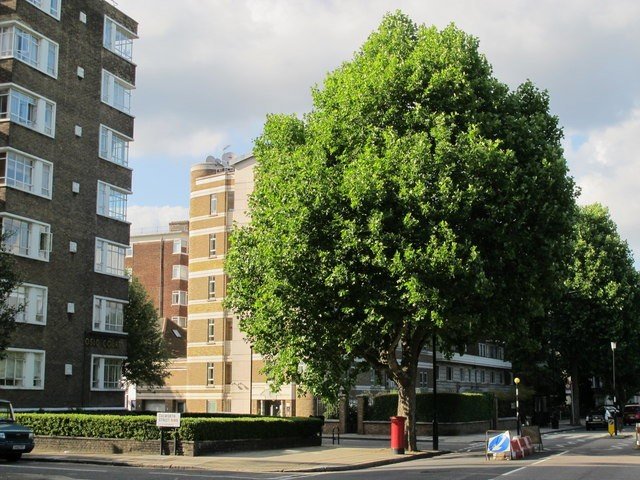
Portland Terrace was a residential frontage overlooking the northern side of Regent’s Park, in the area now addressed as Prince Albert Road. Its houses belonged to an earlier, lower-rise phase of St John’s Wood, before large mansion blocks transformed this park boundary. The open landscape opposite gave the terrace a spacious outlook, while the adjoining streets connected it with the developing neighbourhood around St John’s Wood High Street.

North Gate, built around 1907 on the site of the terrace, shows the scale of that transformation. Designed by Edward Prioleau Warren, the mansion block provided substantial flats where separate houses had previously stood; a further extension followed in the 1930s. The setting still combines a busy residential road with the trees and open space of the park. The profiles below use the old Portland Terrace house numbers, not modern flat numbers or a reconstruction of today’s addresses.

History sources
Explore its people and history
Prince Albert Road at Charlbert Street, near the former Portland Terrace frontage; photograph by Mike Quinn, Wikimedia Commons, CC BY-SA 2.0.
Prince Albert Road at Charlbert Street, near the former Portland Terrace frontage; photograph by Mike Quinn, Wikimedia Commons, CC BY-SA 2.0. Mike Quinn · Wikimedia Commons · CC BY-SA 2.0

This history is growing. Further directory research and photographs will be added.

Thomas Sidney Cooper, self-portrait; Wikimedia Commons, public domain.
Thomas Sidney Cooper, self-portrait; Wikimedia Commons, public domain. Thomas Sidney Cooper · Wikimedia Commons · Public domain

02 / People behind the doors

Portland Terrace’s
people and stories.

A few lives that connect this neighbourhood with a much wider story.

Thomas Sidney Cooper

Historical No. 13 Portland Terrace · listed as an artist in 1834 and 1836

Cooper became celebrated for landscapes populated by cattle and sheep. Born in Canterbury, he rose from childhood poverty to become a Royal Academician and painted for Queen Victoria. His long career also had a local philanthropic legacy: he founded an art school and gallery in Canterbury. Boyle’s records him here near the beginning of his London exhibiting career.

Sources and directory references

Selected directory observations: Boyle’s 1834, PDF page 166, column 1: 13 T. Sidney Cooper, art; Boyle’s 1836, PDF page 176, column 1: 13 T. S. Cooper, art.. Page references are PDF pages. These observations do not establish continuous residence.


Alfred Clint

Historical No. 9 Portland Terrace · listed as an artist in 1834

Clint painted portraits and landscapes before becoming particularly associated with coastal and marine scenes. Trained by his father, the artist George Clint, he began exhibiting in the late 1820s. He later became president of the Society of British Artists, serving from 1869 to 1881. This is the English painter born in 1807, rather than his son of the same name who worked in Australia.

Sources and directory references

Selected directory observations: Boyle’s 1834, PDF page 166, column 1: 9 Alfred Clint, art.. Page references are PDF pages. These observations do not establish continuous residence.

Allan Wyon

Historical No. 26 Portland Terrace · listed in 1876–77

Wyon belonged to a distinguished family of medal makers and seal engravers. He succeeded his brothers as chief engraver of the seals, and his work included the Royal Society’s Darwin Medal, first awarded to Alfred Russel Wallace in 1890. The directory entries belong to Allan Wyon, born in 1843, before the birth of his sculptor son Allan Gairdner Wyon.

Sources and directory references

Selected directory observations: Webster’s 1876, printed page 197 (PDF page 260), column 1: 26 WYON, Allan; Webster’s 1877, printed page 199 (PDF page 262), column 1: 26 WYON, Allan. Page references are PDF pages. These observations do not establish continuous residence.

04 / Keep exploring

More history.
Freely discovered.

These collections are a good place to follow your curiosity. Browse their online records free; copies, downloads or permission to reproduce images may carry a charge.

Streets.London is a project by Infrastructure.London.
More ways we care for London’s homes and gardens.

Your details, thoughtfully handled.

Who we are. Streets.London is a project of London Infrastructure Solutions.

Launch updates. With your consent, we use your email address, optional street and postcode interests, the page where you signed up, and any organisation and property-count details you provide to handle group enquiries and send Streets.London launch and record-availability updates. These details are submitted to Brevo to manage our subscriber list. The optional email-update form does not create an account or purchase anything. Free account registration is separate; see our account privacy notice.

Keeping and removing your details. We keep signup information while it is needed for these updates. You can withdraw consent, ask for a copy or correction, or request deletion using the unsubscribe link in our emails, by replying to an update from us or using the London Infrastructure Solutions contact form. We will stop updates when you withdraw consent.

Services we use. Our hosting provider serves this website. Brevo processes signup details and manages our email updates, while Cloudflare Turnstile checks for automated abuse. These providers may process information outside the UK. We do not sell your signup information.

Analytics. If you allow optional analytics, Google Analytics helps us understand page visits and completed signups. We do not send your form email address, street interest or postcode to Google Analytics. Your cookie choice is stored on this device and can be changed using “Cookie choices”.

Your rights. You may ask us to access, correct or delete your information or withdraw consent. You can also raise a concern with the UK Information Commissioner’s Office at ico.org.uk.

Last updated: 15 November 2026.