01 / Paddington · W2

Somers Place
History behind the address.

Somers Place was a residential address in the Cambridge Square neighbourhood north of Hyde Park. Early-twentieth-century directories describe its position between Radnor Place and Southwick Crescent, within the planned streets of Tyburnia. This part of Paddington developed from the 1830s as a district of substantial houses, garden squares and quieter connecting streets, set behind the main routes around the park.

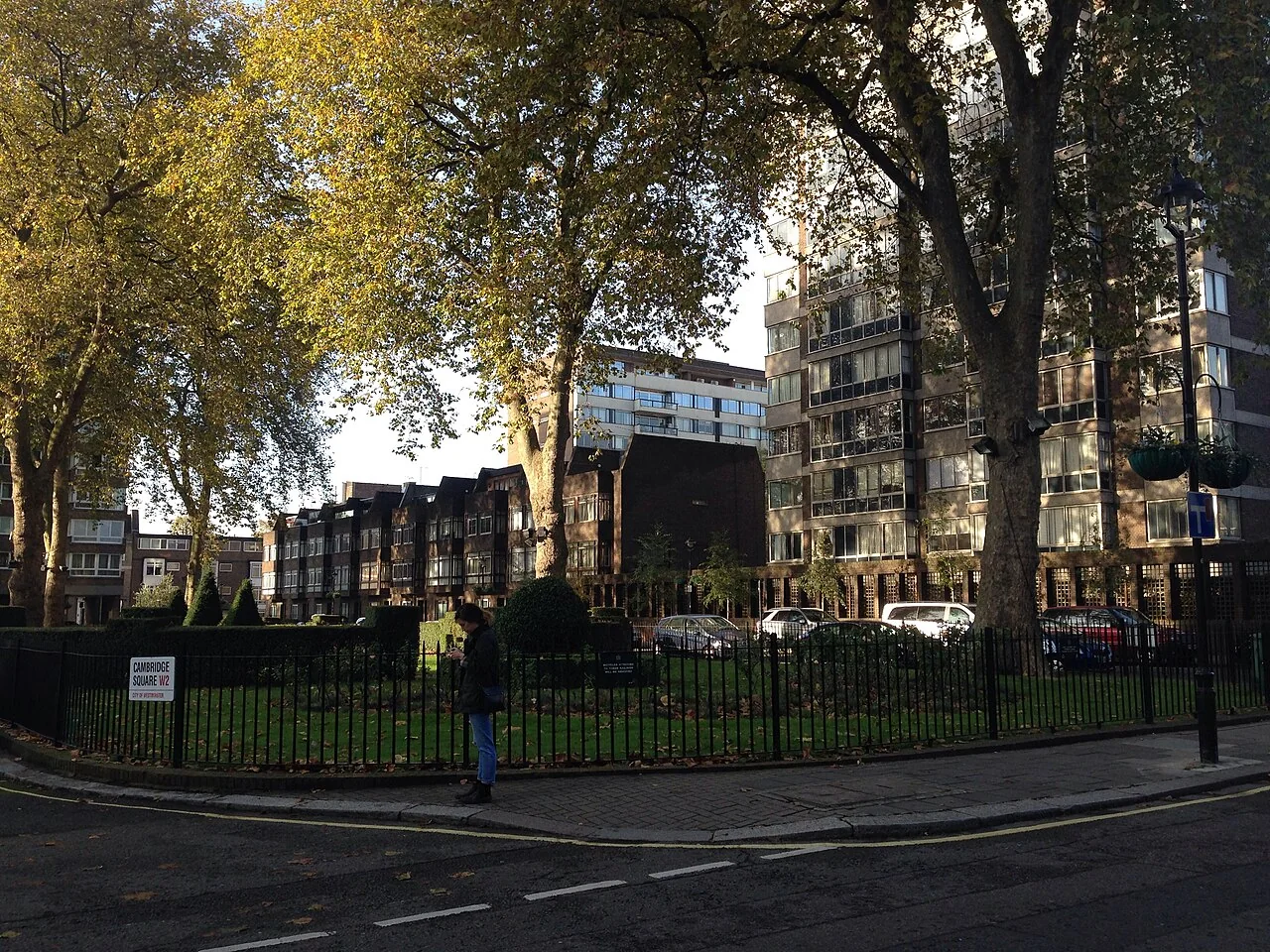
Much of the surrounding Victorian housing was replaced during twentieth-century redevelopment. Cambridge Square’s garden and mature trees provide continuity with that earlier landscape, even where the buildings around them have changed. The old directory numbers belong to this historical streetscape and should not be read as present-day house numbers. The accompanying photograph shows neighbouring Cambridge Square as context for Somers Place, rather than a surviving house identified with one of its residents.

History sources
Explore its people and history
Neighbouring Cambridge Square, shown as context for the historical Somers Place address; photograph credited in the image source.
Neighbouring Cambridge Square, shown as context for the historical Somers Place address; photograph credited in the image source. Gareth E. Kegg · Wikimedia Commons · CC BY-SA 4.0

This history is growing. Further directory research and photographs will be added.

Charles Joseph Singer and Dorothea Waley Singer, photographed together later in life; Wellcome Collection via Wikimedia Commons, CC BY 4.0.
Charles Joseph Singer and Dorothea Waley Singer, photographed together later in life; Wellcome Collection via Wikimedia Commons, CC BY 4.0. Photographer unknown; Wellcome Collection · Wikimedia Commons · CC BY 4.0

02 / People behind the doors

Somers Place’s
people and stories.

A few lives that connect this neighbourhood with a much wider story.

Dorothea Waley Singer

Historical No. 4 Somers Place

Singer was a historian of medieval medicine and science whose work included a major catalogue of alchemical manuscripts and a study of Giordano Bruno. She also helped scholars displaced by Nazi persecution.

Sources and directory references

Selected directory observations: Kelly’s Post Office Directory 1914, PDF page 470, column 3: 4 Singer Charles, M.D. Page references are PDF pages. These observations do not establish continuous residence.

Charles Singer

Historical No. 4 Somers Place

Originally trained in medicine, Singer became a leading historian of science, medicine and technology. His books ranged from ancient biology to the development of scientific ideas, and he helped edit the substantial History of Technology. He and Dorothea often worked together; both received the History of Science Society’s Sarton Medal in 1956. These listings precede their move to Oxford.

Sources and directory references

Selected directory observations: Kelly’s Post Office Directory 1914, PDF page 470, column 3: 4 Singer Charles, M.D. Page references are PDF pages. These observations do not establish continuous residence.

John Mowlem

Historical No. 15 Somers Place · listed in 1862–63

Mowlem began as a stonemason and established the business that became one of Britain’s major building contractors. His early London work included paving and the supply of stone, with granite quarried in Guernsey forming part of the enterprise. He later devoted time and money to his native Swanage, while the business continued under his partners George Burt and Joseph Freeman.

Sources and directory references

Selected directory observations: Webster’s 1862, printed page 188 (PDF page 243), column 2: 15 MOWLEM, John; Webster’s 1863, printed page 188 (PDF page 233), column 2: 15 MOWLEM , John. Page references are PDF pages. These observations do not establish continuous residence.

04 / Keep exploring

More history.
Freely discovered.

These collections are a good place to follow your curiosity. Browse their online records free; copies, downloads or permission to reproduce images may carry a charge.

Streets.London is a project by Infrastructure.London.
More ways we care for London’s homes and gardens.

Your details, thoughtfully handled.

Who we are. Streets.London is a project of London Infrastructure Solutions.

Launch updates. With your consent, we use your email address, optional street and postcode interests, the page where you signed up, and any organisation and property-count details you provide to handle group enquiries and send Streets.London launch and record-availability updates. These details are submitted to Brevo to manage our subscriber list. The optional email-update form does not create an account or purchase anything. Free account registration is separate; see our account privacy notice.

Keeping and removing your details. We keep signup information while it is needed for these updates. You can withdraw consent, ask for a copy or correction, or request deletion using the unsubscribe link in our emails, by replying to an update from us or using the London Infrastructure Solutions contact form. We will stop updates when you withdraw consent.

Services we use. Our hosting provider serves this website. Brevo processes signup details and manages our email updates, while Cloudflare Turnstile checks for automated abuse. These providers may process information outside the UK. We do not sell your signup information.

Analytics. If you allow optional analytics, Google Analytics helps us understand page visits and completed signups. We do not send your form email address, street interest or postcode to Google Analytics. Your cookie choice is stored on this device and can be changed using “Cookie choices”.

Your rights. You may ask us to access, correct or delete your information or withdraw consent. You can also raise a concern with the UK Information Commissioner’s Office at ico.org.uk.

Last updated: 15 November 2026.