01 / Hyde Park · W2

Stanhope Place
History behind the address.

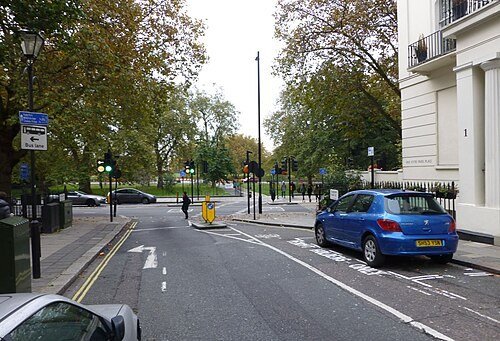
Stanhope Place forms part of Tyburnia, the planned residential district developed on the Bishop of London’s estate north of Hyde Park. Samuel Pepys Cockerell prepared the original scheme, which George Gutch modified as building proceeded after 1827. The matching terraces at Nos. 1–5 and 11–15 date from around 1840–45 and were probably designed by George Ledwell Taylor.

The houses use pale stucco, slate roofs and classical entrance porches to create a consistent streetscape. Continuous first-floor balconies link the individual façades, while projecting end houses give the opposing terraces a balanced composition. Basement areas sit behind iron railings, separating the pavement from the lower domestic rooms. These features preserve the formal character of a neighbourhood planned around substantial urban houses and nearby garden squares.

History sources
Explore its people and history
Stanhope Place
Stanhope Place looking towards its garden-square surroundings, photographed by Russel Wills; Wikimedia Commons. Russel Wills · Wikimedia Commons · CC BY-SA 2.0

This history is growing. Further directory research and photographs will be added.

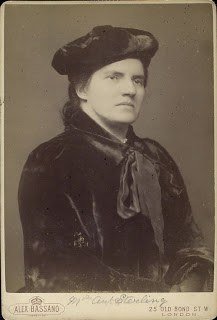
Antoinette Sterling, photographed by Alexander Bassano; Wikimedia Commons, public domain.
Antoinette Sterling, photographed by Alexander Bassano; Wikimedia Commons, public domain. Alexander Bassano · Wikimedia Commons · Public domain

02 / People behind the doors

Stanhope Place’s
people and stories.

A few lives that connect this neighbourhood with a much wider story.

Antoinette Sterling

No. 3 Stanhope Place · listed as Madame Sterling in 1888

Sterling was an American contralto who became particularly popular in Britain through her performances of sentimental ballads. Her success belonged to a concert culture that brought familiar songs to large audiences, making her a recognisable figure in late Victorian musical life.

Sources and directory references

Selected directory observations: Webster’s 1888, printed page 255 (PDF page 344), column 2: 3 STERLING, Madame.. Page references are PDF pages. These observations do not establish continuous residence.

William Pole

No. 9 Stanhope Place · listed in 1888

Pole combined civil engineering with astronomy and music. He also wrote about whist, applying analytical methods to the card game. His varied interests connect the practical sciences with the musical and recreational culture of nineteenth-century Britain.

Sources and directory references

Selected directory observations: Webster’s 1888, printed page 255 (PDF page 344), column 2: 9 POLE, Dr.William, F.R.S... Page references are PDF pages. These observations do not establish continuous residence.

Richard Vicars Boyle

No. 9 Stanhope Place · listed in 1871

Boyle was an Irish civil engineer whose career included pioneering railway work in Japan. Earlier, he had played a prominent role in the defence of Arrah during the Indian uprising of 1857. His life linked engineering projects with major events in Britain’s overseas relationships.

Sources and directory references

Selected directory observations: Webster’s 1871, printed page 213 (PDF page 254), column 2: 9 BOYLE , R. V. C.S.I... Page references are PDF pages. These observations do not establish continuous residence.

04 / Keep exploring

More history.
Freely discovered.

These collections are a good place to follow your curiosity. Browse their online records free; copies, downloads or permission to reproduce images may carry a charge.

Streets.London is a project by Infrastructure.London.
More ways we care for London’s homes and gardens.

Your details, thoughtfully handled.

Who we are. Streets.London is a project of London Infrastructure Solutions.

Launch updates. With your consent, we use your email address, optional street and postcode interests, the page where you signed up, and any organisation and property-count details you provide to handle group enquiries and send Streets.London launch and record-availability updates. These details are submitted to Brevo to manage our subscriber list. The optional email-update form does not create an account or purchase anything. Free account registration is separate; see our account privacy notice.

Keeping and removing your details. We keep signup information while it is needed for these updates. You can withdraw consent, ask for a copy or correction, or request deletion using the unsubscribe link in our emails, by replying to an update from us or using the London Infrastructure Solutions contact form. We will stop updates when you withdraw consent.

Services we use. Our hosting provider serves this website. Brevo processes signup details and manages our email updates, while Cloudflare Turnstile checks for automated abuse. These providers may process information outside the UK. We do not sell your signup information.

Analytics. If you allow optional analytics, Google Analytics helps us understand page visits and completed signups. We do not send your form email address, street interest or postcode to Google Analytics. Your cookie choice is stored on this device and can be changed using “Cookie choices”.

Your rights. You may ask us to access, correct or delete your information or withdraw consent. You can also raise a concern with the UK Information Commissioner’s Office at ico.org.uk.

Last updated: 15 November 2026.